
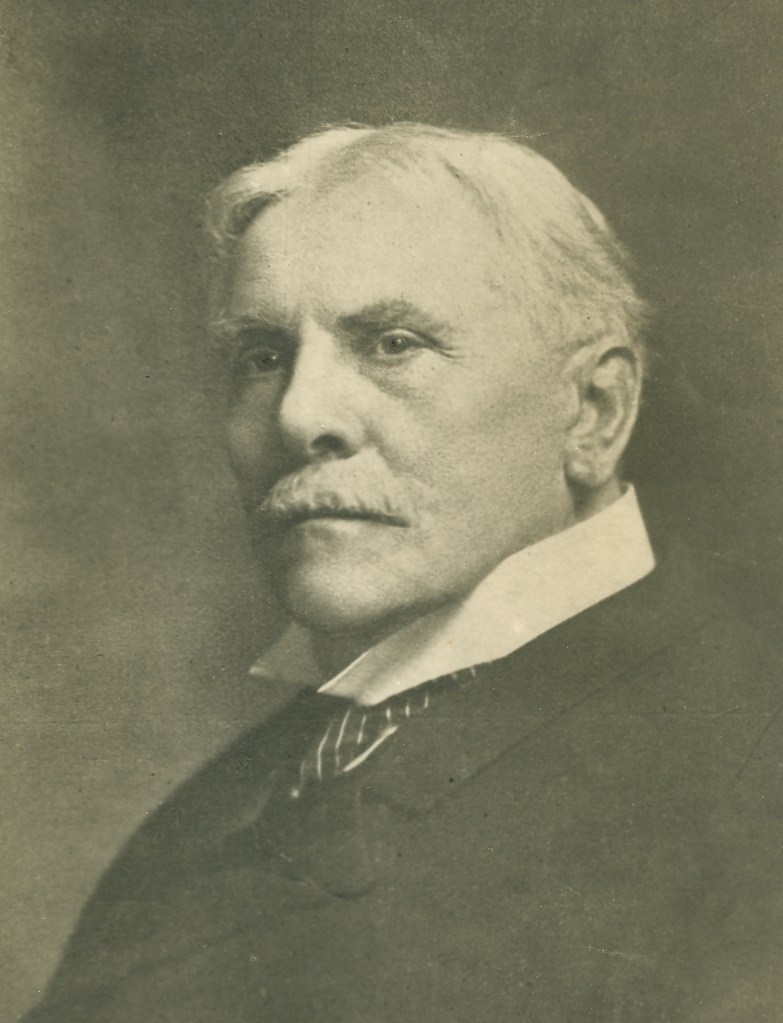
Cyrus Ingerson Scofield (August 19, 1843 – July 24, 1921) was an American theologian, minister, and author known for his widely read annotated Bible, which helped promote futurism and dispensationalism among fundamentalist Christians.
Cyrus Scofield was born in Clinton Township, Lenawee County, Michigan, as the seventh and final child of Elias and Abigail Goodrich Scofield. Elias Scofield’s lineage traced back to English and Puritan origins, although the family was primarily Episcopalian in name. Abigail Scofield passed away three months after Cyrus was born, and his father remarried twice while Cyrus was growing up. While the specifics of his early education remain unclear, there is no reason to disbelieve his later claims that he was a passionate reader who had engaged with the works of Shakespeare and Homer.
By 1861, Scofield was residing with family in Lebanon, Tennessee. At the start of the American Civil War, 17-year-old Scofield joined the 7th Tennessee Infantry, C.S.A., as a private, participating in battles at Cheat Mountain, Seven Pines, and Antietam. In 1862, after a month in Chimborazo Hospital in Richmond, Virginia, Scofield successfully requested a discharge. He then returned to Lebanon but was drafted again into Confederate service. Assigned to McMinnville, Tennessee, Scofield deserted and crossed over to Union lines in Bowling Green, Kentucky. After pledging allegiance to the Union, he was granted safe passage to St. Louis, Missouri, where he settled down.
In 1866, he wed Leontine LeBeau Cerrè, who was part of a well-known French Catholic family in St. Louis. Scofield undertook an apprenticeship in his brother-in-law’s law firm and subsequently worked in the assessor’s office in St. Louis before relocating to Atchison, Kansas, at the end of 1869. In 1871, he was elected to the Kansas House of Representatives, first representing Atchison for one year and then Nemaha County for a second term. In 1873, he campaigned for John J. Ingalls’s election as senator from Kansas, and once Ingalls was victorious, he had Scofield appointed as U.S. District Attorney for Kansas—making him the youngest in the nation at 29. However, later that same year, Scofield was compelled to resign amid scandal due to dubious financial dealings, which may have involved accepting bribes from railroad companies, misappropriating political donations meant for Ingalls, and obtaining bank promissory notes through forged signatures. It’s possible that Scofield faced jail time for forgery, although no definitive evidence exists in public records.
Due in part to his own acknowledgment of excessive drinking, Scofield left his wife and two daughters during this time. In 1883, Leontine Cerrè Scofield divorced him for abandonment, and that same year, he married Hettie Hall von Wartz, with whom he later had a son.
As stated by Scofield, he embraced evangelical Christianity due to the influence of a lawyer friend. By late autumn of 1879, Scofield was actively involved in Dwight L. Moody’s evangelistic effort in St. Louis and held the position of secretary at the St. Louis YMCA. Notably, he became a mentee of James H. Brookes, who was the pastor of Walnut Street Presbyterian Church in St. Louis and a well-known proponent of dispensationalist premillennialism.
In October 1883, Scofield was ordained as a minister in the Congregationalist denomination while his divorce was underway but not yet finalized. He took on the role of pastor at a small mission church established by this denomination, which later became known as the First Congregational Church of Dallas, Texas (now called Scofield Memorial Church). Under his leadership, the church’s membership grew from fourteen to over five hundred before he stepped down as pastor in 1895. That same year, Scofield was appointed pastor of Moody’s church, the Trinitarian Congregational Church located in East Northfield, Massachusetts. Additionally, he sought to lead Moody’s Northfield Bible Training School but with limited success.
In 1888, Scofield participated in the Niagara Bible Conference, where he encountered Hudson Taylor, a trailblazing missionary to China. Taylor’s methodology in Christian missions inspired Scofield to establish the Central American Mission in 1890, which is currently known as Camino Global. Additionally, Scofield held the position of superintendent for the American Home Missionary Society in Texas and Louisiana. He also launched Lake Charles College in Lake Charles, Louisiana, which operated from 1890 to 1899.
As the writer of the pamphlet “Rightly Dividing the Word of Truth” (1888), Scofield quickly emerged as a prominent figure in dispensational premillennialism, which laid the groundwork for Christian fundamentalism in the twentieth century. Although Scofield theoretically returned to his role as pastor in Dallas in 1903, his efforts on the anticipated reference Bible took up much of his time, and he spent a considerable amount of time either ill or abroad in Europe. Once the Scofield Reference Bible was released in 1909, it rapidly became the most impactful representation of dispensational premillennialism, and Scofield gained popularity as a speaker at Bible conferences even as his health worsened. The royalties from this publication were significant, enabling Scofield to acquire properties in Dallas, Ashuelot in New Hampshire, and Douglaston in Long Island. He also became a member of the esteemed Lotos Club.
Scofield departed from the progressive Congregational Church to join the Southern Presbyterian Church and relocated to the New York City region, where he oversaw a correspondence and lay education institute known as the New York Night School of the Bible. In 1914, he established the Philadelphia School of the Bible in Philadelphia, Pennsylvania (now known as Cairn University).
In the early 1890s, Scofield started referring to himself as Rev. C. I. Scofield, D.D.; however, there are no available records indicating that any educational institution awarded him the honorary Doctor of Divinity degree. His second wife was a loyal partner and editing aide, but he had a distant relationship with his children, including librarian Abigail Scofield Kellogg. Scofield passed away at his residence on Long Island in 1921.
Scofield’s correspondence Bible study program served as the foundation for his Reference Bible, an annotated study Bible that gained wide circulation after its initial publication by Oxford University Press in 1909. Scofield’s annotations promote futurism and dispensationalism, a theological view developed in the early 1800s by John Nelson Darby, an Anglo-Irish minister who, like Scofield, was trained in law. Dispensationalism highlights the differences between the New Testament Church and the ancient Israel of the Old Testament. Scofield posited that there are seven distinct periods of God’s interactions with humanity from creation to the final judgment, and these periods provide a framework for interpreting the Bible’s messages. Scofield’s notes significantly contributed to the rise of dispensational premillennialism among fundamentalist Christians in the U.S., becoming a key resource for popular religious authors like Hal Lindsey.
Scofield had a major impact on the Christian Zionist movement. In the Scofield Bible, he stated that antisemitism is a sin. Referring to Genesis 12:3—”I will bless them that bless thee”—Scofield contended that “Any person or nation that speaks out against Israel invites God’s wrath.”
Scofield adhered to a trichotomous view of humanity, seeing people as consisting of body, soul, and spirit, and believed that this tripartite nature reflects the image of the triune God.
Cyrus Scofield was aligned with Calvinist beliefs but rejected the idea of limited atonement and sought to promote a more lenient interpretation of the perseverance of the saints. He dismissed the concept of deriving assurance from sanctification. Scofield’s views on eternal rewards have shaped the perspectives of contemporary Free Grace theologians.




Leave a comment