
For our citizenship is in heaven, from which also we eagerly wait for a Savior, the Lord Jesus Christ; who will transform the body of our humble state into conformity with the body of His glory, by the exertion of the power that He has even to subject all things to Himself.
Philippians 3:20-21
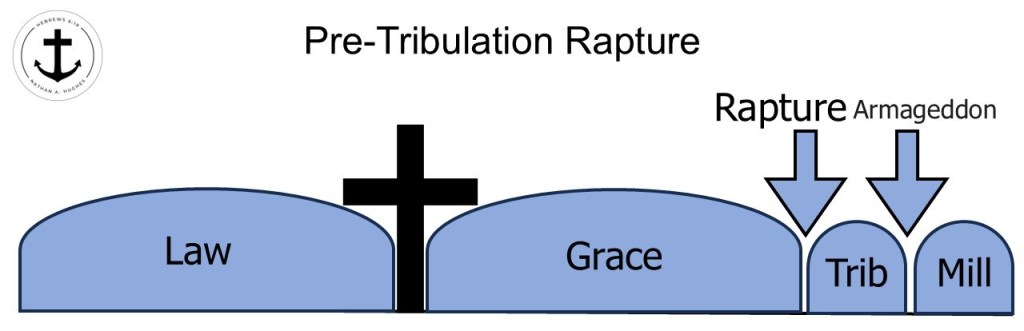
I will be transparent and candid in stating from the outset that I subscribe to the belief in the Pre-Tribulation Rapture. In this discourse, I intend to delineate several clear and straightforward reasons for my conviction. I hold the view that the sole position the Bible espouses concerning the rapture is the pre-tribulation stance.
In John 14 the Lord Jesus Christ says that in the Father’s house are many mansions and that he is preparing a place for us (John 14:2). He states in verse 3, “And if I go and prepare a place for you, I will come again, and receive you to Myself; that where I am, there you may be also.”
The Lord Jesus Christ said that he would come again and receive His Church.
The Bible says in 1 Thessalonians 4:15-16, “For this we say to you by the word of the Lord, that we who are alive, and remain until the coming of the Lord, shall not precede those who have fallen asleep. For the Lord Himself will descend from heaven with a shout, with the voice of the archangel, and with the trumpet of God; and the dead in Christ shall rise first.”
The Bible clearly teaches that Christ will come again and the dead in Christ will be raised to life. This Scripture points to the rapture of the Church. The Bible continues in verses 17-18, “Then we who are alive and remain shall be caught up together with them in the clouds to meet the Lord in the air, and thus we shall always be with the Lord. Therefore comfort one another with these words.
The rapture is a comfort because we can have assurance that the Lord Jesus Christ is coming back for His Church.
In 2 Thessalonians 2:3 the Bible says, “Let no one in any way deceive you, for it will not come unless the apostasy comes first, and the man of lawlessness is revealed, the son of destruction.” The note in the Scofield Reference Bible for 2 Thessalonians 2:3 is very helpful.

THE EVENTS LEADING TO THE DAY OF THE LORD
The order of events is:
(1) The working of the mystery of lawlessness under divine restraint which had already begun in the apostle’s time 2Th. 2:7
(2) the apostasy of the professing church 2Th. 1:3; Luk. 18:8; 2Ti. 3:1-8.
(3) the removal of that which restrains the mystery of lawlessness 2Th. 2:6; 2Th. 2:7. The restrainer is a person–“he,” and since a “mystery” always implies a supernatural element (See Scofield on Mat. 13:11) this Person can be none other than the Holy Spirit in the church, to be “taken out of the way”; 2Th. 2:7; 1Th. 4:14-17.
(4) the manifestation of the lawless one 2Th. 2:8-10; Dan. 7:8; Dan. 9:27; Mat. 24:15; Rev. 13:2-10
(5) the coming of Christ in glory and the destruction of the lawless one 2Th. 2:8; Rev. 19:11-21
(6) the day of Jehovah 2Th. 2:9-12; Isa. 2:12
Old Scofield Reference Bible – 2 Thessalonians 2:3
The Early Church Fathers wrote about a pre tribulation rapture in their writings. After the time of the apostles a number of writings pointed to the return of Christ, which is consistent with a pre-tribulation rapture of the Church. Clement of Rome and Ignatius of Antioch among other writings referred to the imminent return of Christ.
Irenaeus of Lyon believed in a pre-tribulation rapture. He wrote, “For Enoch, when he pleased God, was translated in the same body in which he did please Him, thus pointing out by anticipation the translation of the just. Elijah, too, was caught up [when he was yet] in the substance of the [natural] form; thus exhibiting in prophecy the assumption of those who are spiritual, and that nothing stood in the way of their body being translated and caught up.”[1]
Irenaeus refers to the Church’s being “caught up” before the tribulation. “And therefore, when in the end the Church shall be suddenly caught up from this, it is said, ‘There shall be tribulation such as has not been since the beginning, neither shall be’ (Mat 24:21). For this is the last contest of the righteous, in which, when they overcome they are crowned with incorruption.”[2]
Victorinus of Petrovium in his commentary on Revelation (6:14), he writes, “And the heaven withdrew as a scroll that is rolled up. For the heaven to be rolled away, that is, that the Church shall be taken away.”[3]
In Revelation 15, he writes, “And I saw another great and wonderful sign, seven angels having the seven last plagues; for in them is completed the indignation of God. For the wrath of God always strikes the obstinate people with seven plagues, that is, perfectly, as it is said in Leviticus; and these shall be in the last time, when the Church shall have gone out of the midst.”[4]
In a sermon entitled “On the Last Times, the Antichrist, and the End of the World,” Pseudo-Ephraem wrote, “For all the saints and elect of God are gathered, prior to the tribulation that is to come, and are taken to the Lord lest they see the confusion that is to overwhelm the world because of our sins.”[5]
Types & Examples in Scripture
In Scripture there are types and examples of the rapture of the Church. Here are some examples.
Enoch
Genesis 5:24, “And Enoch walked with God; and he was not, for God took him.” Enoch was taken to Heaven by God without dying. This is a type of the rapture as he went to be with the Lord before death.
Noah
The ark is another type of the rapture. The flood was God’s wrath and judgement on the earth. Before God sent the flood Noah and his family were saved from the wrath and judgement of God by entering the ark.
Moses
The Book of Exodus is all about how God delivered the children of Israel. Turn to Exodus 14:21-30 and read how God used Moses to deliver the children of Israel.
Elijah
2 Kings 2:3 says, “Then the sons of the prophets who were at Bethel came out to Elisha and said to him, “Do you know that the Lord will take away your master from over you today?” And he said, “Yes, I know; be still.” In 2 Kings 2 the Lord takes Elijah in heaven by a whirlwind. This is a example of a godly person being taken out of the world by God before death.
Paul
In 2 Corinthians 12 Paul writes about one that was “caught up to the third heaven” (verse 2). The first heaven is the clouds, the second heaven is the stars and the third heaven is the abode of God.
John
In Revelation 4:1 there is a call to, “Come up here.” This call seems to indicate the fulfilment of 1 Thessalonians 4:14-17. The word “church” does not again occur in the Book of Revelation until 22:16, till all is fulfilled. The viewpoint of John is from heaven. The catching up of John from earth to heaven is symbolic of the rapture of the church before the events of the tribulation occurs as recorded in Revelation chapters 6 to 19.

Pre-tribulationism posits that the Rapture transpires prior to the commencement of the Tribulation. During this event, the church will ascend to meet Christ in the air, following which the Antichrist will be unveiled and the Tribulation will commence. In essence, there exists a minimum separation of seven years between the Rapture and Christ’s Second Coming, which is intended to establish His kingdom. This perspective asserts that the church is not subjected to any part of the Tribulation.
From a scriptural standpoint, the pretribulation perspective has several points in its favor. For instance, the church is not appointed to wrath (1 Thessalonians 1:9-10, 5:9), and believers will not be caught unawares by the Day of the Lord (1 Thessalonians 5:1-9). The church in Philadelphia was assured that it would be safeguarded from “the hour of trial that is about to come upon the entire world” (Revelation 3:10). It is important to note that the promise indicates not just preservation during the trial, but rather deliverance from the specific time of the trial itself.
Pretribulationism is also backed by what is absent from Scripture. The term “church” occurs nineteen times in the initial three chapters of Revelation, but notably, it is not mentioned again until chapter 22. This means that throughout the extensive depiction of the Tribulation in Revelation, the term church is clearly missing. In reality, the Bible does not mention the word “church” in any context regarding the Tribulation.
Pretribulationism is the sole theory that distinctly preserves the separation between Israel and the church, along with God’s unique intentions for each. The seventy “sevens” mentioned in Daniel 9:24 are assigned to Daniel’s people (the Jews) and to Daniel’s sacred city (Jerusalem). This prophecy clearly indicates that the seventieth week (the Tribulation) serves as a period of purification and recovery for Israel and Jerusalem, rather than for the church.
The pretribulational perspective appears to align best with God’s nature and His desire to save the righteous from judgment. Instances of God’s deliverance in the Bible include Noah, who was saved from the global flood; Lot, who was rescued from Sodom; and Rahab, who was spared from Jericho.
We can see by reading and believing God’s Word that the only view that is in keeping with Scripture is the pre-tribulation rapture. The Church is the bride of Christ; he will not suffer his bride to go through the tribulation. The Church will be taken out of the world before the tribulation occurs.
And the Spirit and the bride say, “Come.” And let the one who hears say, “Come.” And let the one who is thirsty come; let the one who wishes take the water of life without cost.
Revelation 22:17
[1] Irenaeus, Against Heresies, 5:5.
[2] Ibid., 5:29.
[3] Victorinus, Commentary on the Apocalypse of the Blessed John, 6.14.
[4] Ibid., 15.1.
[5] Paul J. Alexander, The Byzantine Apocalyptic Tradition (Berkeley, CA: University of California Press, 1985), 210.



Leave a comment