
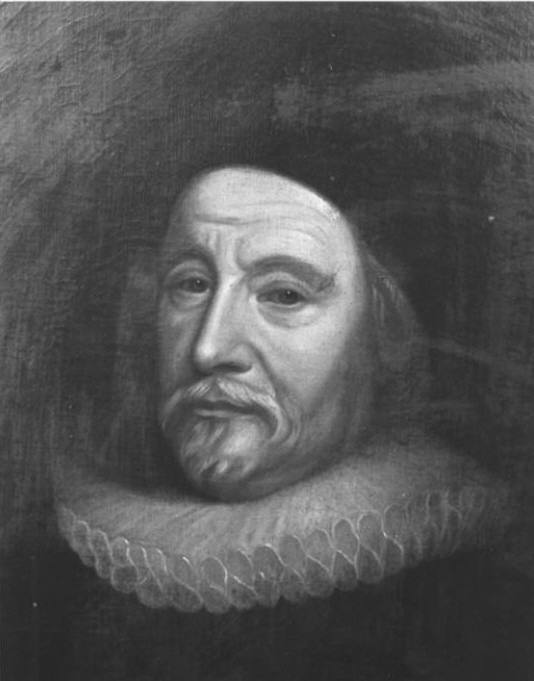
James Ussher was Archbishop of Armagh, Primate of All Ireland, theologian, historian, and chronologist. He was born on 4 January 1581 in Dublin, Ireland, into a well-connected Anglo-Irish Protestant family. His father, Arland Ussher, was Clerk of the Irish Court of Chancery, and his mother, Margaret Stanihurst, came from a prominent scholarly lineage, her brother Richard Stanihurst was a noted historian and translator. From childhood, Ussher displayed unusual intellectual ability, particularly in languages and theological studies.
At the age of 13, Ussher entered the newly founded Trinity College Dublin (1594), becoming one of its earliest students. He excelled rapidly, earning his BA (1598), MA (1601), BD (Bachelor of Divinity, 1607), and DD (Doctor of Divinity, 1612). While at Trinity, he committed himself to the study of Scripture, the Church Fathers, and the Reformed theological tradition, mastering Latin, Greek, Hebrew, Aramaic, Syriac, and later Arabic, an extraordinary range even among Renaissance scholars.
Ministerial Career and Ecclesiastical Rise
Ussher was ordained as a deacon and priest in the Church of Ireland in 1601. His first appointment was as Chancellor of St Patrick’s Cathedral, Dublin (1605). In 1607, at only 26, he became Professor of Divinity at Trinity College, marking the start of his lifelong work combining theology and historical research.
His ecclesiastical influence expanded swiftly. He became the Bishop of Meath in 1621 and Archbishop of Armagh, Primate of All Ireland in 1625.
As Archbishop, Ussher sought to strengthen Protestant unity, defend Reformed doctrine, and maintain ecclesiastical order in Ireland, which was religiously divided and politically unstable. Though part of an episcopal church, Ussher personally leaned toward Calvinist soteriology and held sympathetic views toward certain Presbyterian reforms, especially regarding preaching, discipline, and moral oversight. However, he opposed abolishing episcopacy outright and argued for a moderated, historic form of church governance.
The 1615 Irish Articles
One of Ussher’s earliest major contributions was his role in drafting the Irish Articles of Religion (1615), a doctrinal confession of the Church of Ireland that was more explicitly Calvinist than the later Thirty-Nine Articles of the Church of England. These articles affirmed the authority and sufficiency of Scripture, predestination and election in classic Reformed framing, justification by faith alone and rejection of Roman Catholic doctrines such as transubstantiation and the sacrifice of the Mass.
The Irish Articles later influenced the Westminster Confession of Faith (1646), a key doctrinal standard of the Presbyterian tradition.
Scholarship and Patristic Studies
Ussher believed that historical theology was essential for defending biblical truth. He produced massive works on early church history, councils, creeds, and doctrinal development. His scholarship aimed to demonstrate that Protestant doctrine aligned more closely with the early church than the later medieval Roman Catholic system. His most significant historical work, “Britannicarum Ecclesiarum Antiquitates” (The Antiquities of the British Churches) was published in 1639.
In this, he argued that Christianity reached Britain and Ireland early (possibly 2nd century), and that the ancient Celtic churches maintained doctrinal independence from Rome for centuries, particularly in matters such as Easter dating and ecclesiastical authority.
Ussher was also a major manuscript collector. His library contained thousands of rare documents, including ancient biblical texts and patristic sources. Many of these were later donated to Trinity College and Oxford, forming part of enduring academic collections.
Chronology and the Famous Date of Creation
Ussher is most widely remembered for his chronological work, “Annales Veteris et Novi Testamenti” (1650–1654) (Annals of the Old and New Testaments). Using Biblical genealogies, ancient Near Eastern histories, astronomical calculations and synchronisms with Assyrian, Babylonian, Egyptian, Greek, and Roman records.
Ussher calculated the date of Creation as, “Night preceding 23 October 4004 BC.” He further placed The Flood at 2348 BC, The Exodus at 1491 BC, Solomon’s Temple foundation at 1012 BC and the birth of Christ at 5 BC (due to calendar discrepancies).
This chronology was later printed in the margins of many Authorised King James Bibles, giving it immense cultural influence. While modern science and historical chronology no longer support Ussher’s conclusions, his work remains a landmark in the history of biblical scholarship and demonstrates the depth of his method and intellectual ambition.
Political Turmoil, Civil War, and Exile
The Irish Rebellion of 1641 and the subsequent Wars of the Three Kingdoms (which included the English Civil War) dramatically disrupted Ussher’s life and ministry. With violence spreading across Ireland, Ussher left for England in 1640, never returning to his homeland. His property and ecclesiastical jurisdiction were overtaken by conflict.
Despite being a high-ranking Anglican Archbishop, Ussher was respected by both sides of the war for his personal integrity and scholarship. He avoided political extremism and attempted to mediate between Royalists and Parliamentarians.
After the execution of King Charles I (1649), whom Ussher had loyally supported, he lived quietly under the Commonwealth. Oliver Cromwell reportedly granted him a pension due to admiration for his learning.
Later Years and Death
Ussher spent his final years preaching, writing, and organising his research. Though politically displaced, he remained spiritually active and intellectually prolific.
He died on 21 March 1656 in Reigate, Surrey, England. He was given a state funeral and buried in Westminster Abbey, a remarkable honour, especially considering the political climate and his Irish origins. James Ussher’s reported last words were “O Lord forgive me, especially my sins of omission.”



Leave a comment