
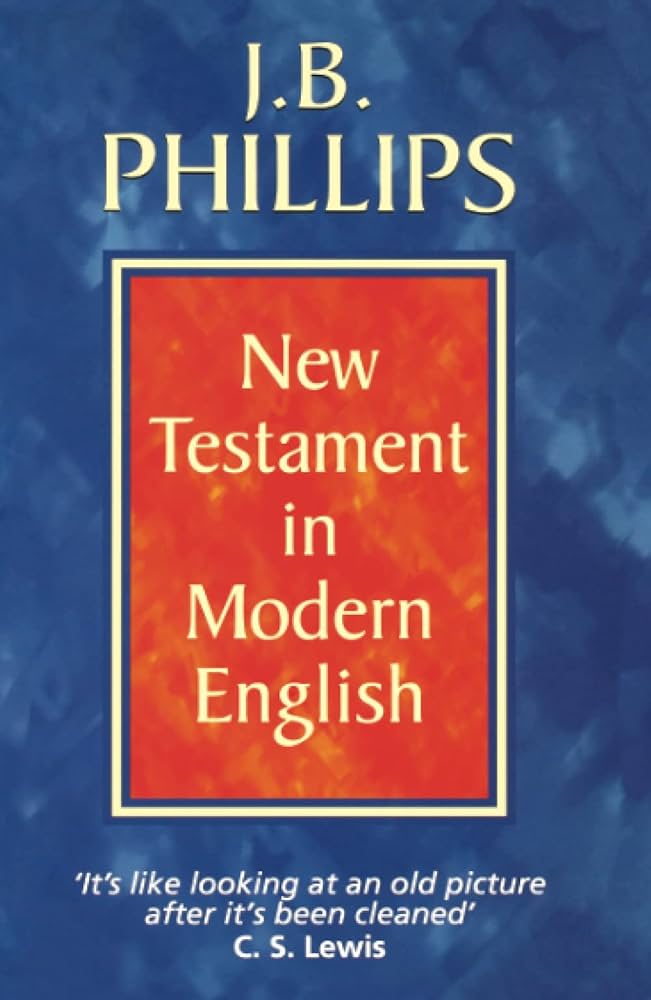
There are some books that don’t merely inform you; they wake you up. For me, J. B. Phillips’ New Testament in Modern English is one of those rare works. It’s not a study Bible, and it doesn’t pretend to be a woodenly literal translation. Instead, it aims to do something deeply pastoral and surprisingly powerful: help modern readers hear the New Testament with fresh ears.
Phillips has a gift for clarity without coldness. His English is lively, direct, and readable in long stretches, especially in the Epistles, yet it often retains the spiritual weight and urgency of the original message. When I read Phillips, I’m reminded that the New Testament wasn’t written as a museum piece. It was written as a living word to real churches facing real pressures, temptations, fears, and hopes. Phillips helps that reality come through.
What I love about it
1) It reads like communication, not a code-book.
One of the greatest strengths of Phillips is his ability to render the sense of a passage without forcing the reader to do heavy lifting just to understand basic meaning. The argument of Romans, the rebukes and comforts in Corinthians, the steady encouragement of Hebrews, these land with a kind of plain-spoken force.
2) It captures tone and urgency.
Phillips often conveys the emotional temperature of a text, joy, warning, tenderness, astonishment, in a way that can get dulled in more formal English. His rendering can feel like someone has opened a window in a room you didn’t realise had become stuffy.
3) It’s wonderfully devotional.
I wouldn’t use Phillips as my only Bible, but I happily use it as a companion. It’s especially useful when familiar passages start to sound like clichés in my mind. Phillips frequently shakes me out of autopilot and brings me back to attention, which is half the battle in Bible reading.
Best uses (how I actually recommend it)
- For first-time readers who find older English difficult.
- For Christians who feel “stuck” in the same wording and need a fresh rendering to re-engage their mind and heart.
- For devotional reading alongside a more formally equivalent translation (I often pair it with something more literal such as the NASB and/or the KJV).
- For teaching and illustration, where clarity and flow help people grasp the argument of a passage quickly.
Critics of the book (and why I still value it)
No translation with Phillips’ goals escapes criticism, and some critiques are fair, depending on what you expect the book to be.
1) “It’s too free—more paraphrase than translation.”
This is the most common complaint. Phillips prioritizes thought-for-thought clarity and natural English expression, and he sometimes departs from tight, word-level correspondence. Critics argue this risks interpretation being smuggled into the text.
My take: That danger exists, and it’s why I don’t treat Phillips as my final authority for detailed exegesis. But the very thing critics dislike is also what makes it uniquely valuable as a reading Bible. Phillips is transparent in what he is trying to do: communicate meaning clearly in modern idiom. Used wisely, it’s a strength, not a flaw.
2) “Some renderings reflect the mid-20th-century context.”
Phillips wrote for his time, and certain phrasing or rhetorical choices can feel dated or shaped by the concerns and English style of that era.
My take: True. Yet the bulk of the work remains remarkably readable, and the occasional dated phrase doesn’t undo the overall clarity. In fact, some of its “older modern English” can be charming and still far more accessible than overly formal renderings.
3) “It smooths out rough edges or compresses ambiguity.”
Where the Greek is layered, abrupt, or ambiguous, Phillips sometimes chooses a clearer path. Critics may say that loses texture.
My take: Again, fair, so I keep a more literal translation close by when studying. But for reading, I’m grateful for a version that helps me follow the argument and feel the weight of the message. Not every reading experience needs to preserve every knot in the wood-grain; sometimes you need to see the whole shape of the table.
Final thoughts
I’d describe J. B. Phillips’ New Testament as a book that has repeatedly helped me listen again. It’s not my only New Testament, and it isn’t meant to replace more formal translations for close study. But it is one of the most effective tools I know for breaking familiarity, restoring clarity, and stirring attentiveness.
If you want a New Testament that reads with warmth, pace, and immediacy, one that often feels like the message is being spoken to you, not merely printed for you, Phillips is a worthy companion on your shelf and in your hands.




Leave a comment