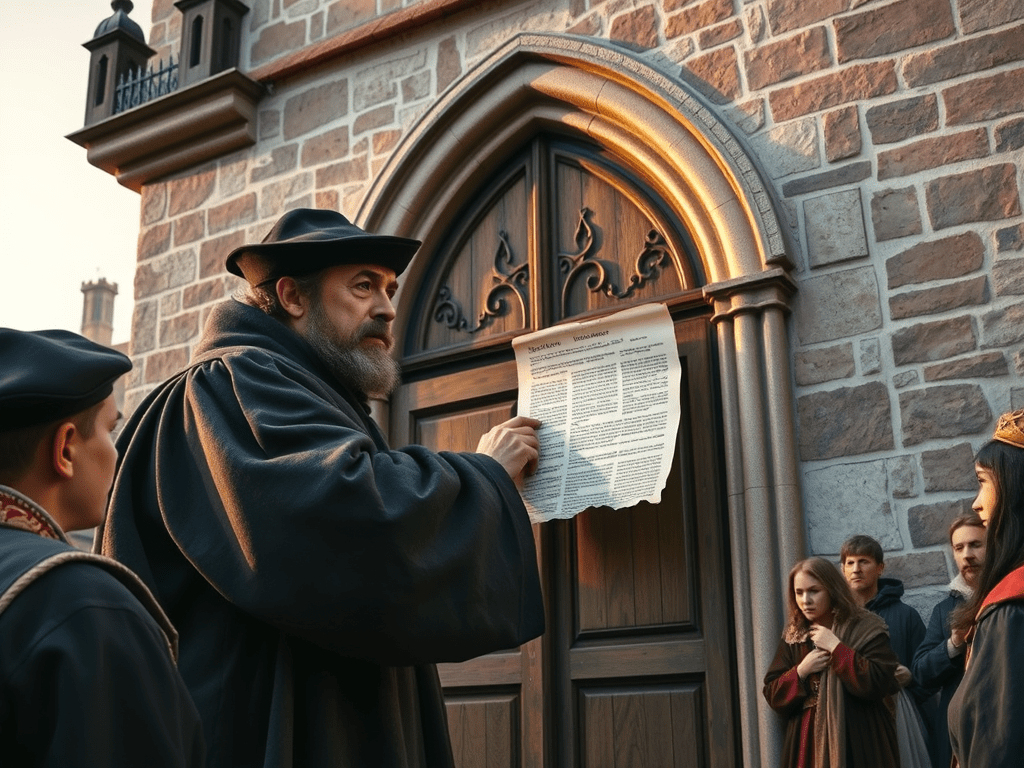
On October 31, 1517, a monk named Martin Luther nailed Ninety-Five Theses to the door of the Castle Church in Wittenberg, Germany, an act that would shake Europe and forever change the course of Christian history. This event marked the beginning of the Protestant Reformation, a movement that sought to return the Church to the authority of Scripture alone and the true gospel of salvation by grace through faith.
A Church in Need of Reform
By the early sixteenth century, many within the church had grown deeply concerned about practices and teachings that had strayed from Scripture. The sale of indulgences, promises of reduced punishment for sin in exchange for money, symbolized a deeper problem: the church had placed human authority and tradition above the Word of God.
Luther and other reformers such as John Calvin, Ulrich Zwingli, and John Knox recognized that the heart of the gospel had been obscured. They called the church back to the teaching of the Apostle Paul, “For by grace you have been saved through faith; and that not of yourselves, it is the gift of God; not as a result of works, so that no one may boast.” Ephesians 2:8–9
This biblical truth, that salvation is entirely the work of God’s grace, received by faith alone, became the foundation of the Reformation.
Scripture Alone as the Final Authority
The Reformers championed Sola Scriptura (“Scripture alone”), insisting that the Bible is the supreme authority for faith and life. Human traditions, councils, and leaders could err, but the Word of God stands forever. As Isaiah wrote,
“The grass withers, the flower fades,
But the word of our God stands forever.”
Isaiah 40:8
By translating Scripture into the languages of the people, reformers ensured that every believer could read and understand God’s Word directly, not relying solely on clerical interpretation. This recovered the biblical vision of the “priesthood of all believers” (1 Peter 2:9).
Luther’s Bold Faith
When called to recant his teachings at the Diet of Worms in 1521, Luther famously declared:
“Unless I am convinced by Scripture and by plain reason… my conscience is captive to the Word of God. Here I stand, I can do no other. God help me.”
That stand for truth was not rebellion for rebellion’s sake, but a courageous act of faithfulness to the gospel. It was a call to reform, to return to the purity of biblical Christianity.
The Legacy of the Reformation
The Protestant Reformation sparked renewal that continues to this day. It gave rise to widespread literacy, Bible translation, congregational worship, and renewed preaching of the gospel. Most importantly, it restored the biblical message of Christ’s finished work on the cross.
“Therefore, having been justified by faith, we have peace with God through our Lord Jesus Christ.”
Romans 5:1
Today, believers remember October 31 not merely as a date in history, but as a reminder of God’s faithfulness in preserving His truth. The Reformation calls every generation to test all teaching by Scripture and to cling to the grace of God in Christ alone.
“The righteous shall live by faith.”
Romans 1:17
Soli Deo Gloria: To God Alone Be the Glory
The Protestant Reformation was, above all, a revival of the gospel, the good news that sinners are saved by grace alone, through faith alone, in Christ alone, according to Scripture alone, to the glory of God alone. On this Reformation Day, we give thanks to God for raising up faithful servants like Martin Luther and countless others who stood courageously for biblical truth.



Leave a comment