
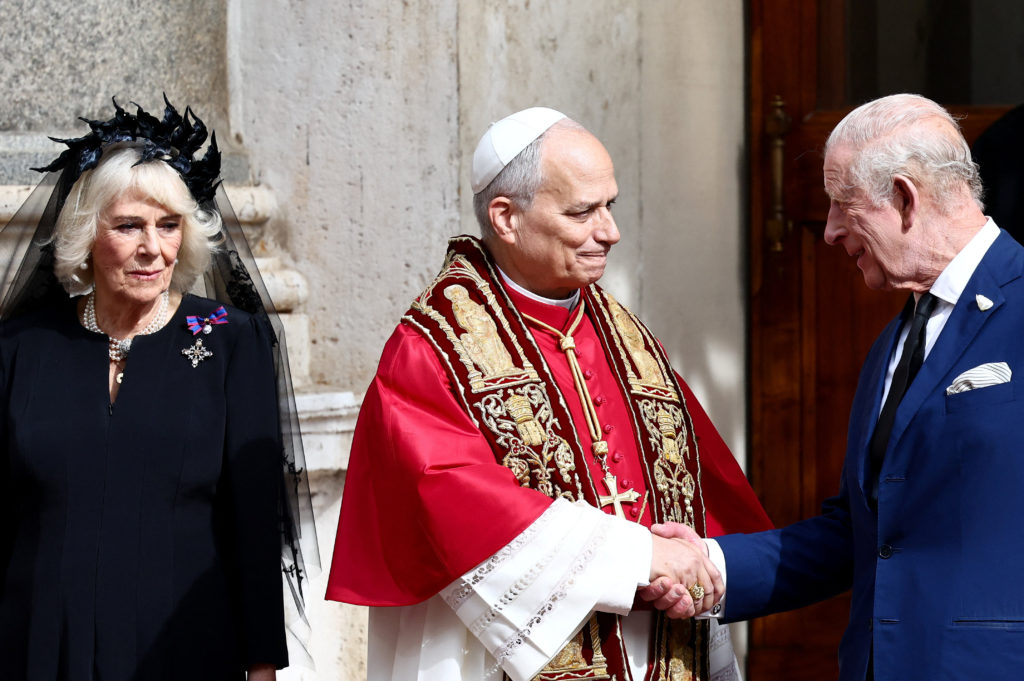
On 23 October 2025, King Charles III and Queen Camilla visited the Vatican and joined Pope Leo in an ecumenical prayer service in the Sistine Chapel, in what was widely hailed as a historic moment of reconciliation between the Church of England and the Roman Catholic Church. The public rejoicing at this symbolic gesture is unsurprising; yet it also invites deeper scrutiny, especially from those who take seriously the constitutional, theological, and historical framework under which the British Crown operates.
One objection, which has already been raised by some conservative Protestant voices, is that the King’s participation in such a joint worship event may conflict with his coronation oaths. Specifically, critics argue that by praying publicly with the Pope, the spiritual head of the Roman Catholic Church, Charles may have breached his solemn promise to “maintain … the Protestant Reformed Religion established by law.”
The Coronation Oath and the King’s Religious Duty
What the King swore
The British monarch, upon coronation, takes an oath that includes a religious dimension: to uphold the Protestant faith and the Church of England as established by law. The wording is rooted in long tradition and statute. In the coronation liturgy of 2023, for example, Charles pledged:
“Will you to the utmost of your power maintain in the United Kingdom the Protestant Reformed Religion established by law? Will you maintain and preserve inviolably the settlement of the Church of England, and the doctrine, worship, discipline, and government thereof, as by law established in England?”
Additionally, Charles had earlier sworn the Accession Declaration Oath, in which he declared himself “a faithful Protestant” and promised to uphold the statutes securing Protestant succession.
The constitutionally and historically entrenched meaning of those promises is that the monarch must act in a manner consistent with preserving the Protestant and Reformed character of the Church of England, and resisting practices or alignments that might undermine that identity.
Why the oath matters
The coronation oath is more than mere symbolism. It is a binding moral and constitutional commitment. According to constitutional precedent and theory, the monarch, in his role as Supreme Governor of the Church of England, must avoid those acts which could compromise the distinctiveness, doctrinal integrity, or legal settlement of the Church of England. The oath further reflects the post-Reformation settlement in which the Crown severed institutional allegiance to the Pope and asserted the Church of England’s autonomy.
From that perspective, any act by the monarch that creates or strengthens religious convergence, especially in a liturgical or worship setting, with the Roman Catholic Church, risks undermining the very separation from Rome that defines the Anglican establishment.
Why the Meeting with Pope Leo May Have Violated That Oath
Given the background, here is how the meeting on 23 October might be seen as a violation of the King’s oath:
1. Public joint worship with the Pope blurs lines of confessional identity
A state-sanctioned act of prayer with the Pope, in the highly symbolic setting of the Sistine Chapel, is hardly a neutral act. It publicly suggests a spiritual communion (or at least affinity) between the monarch’s role in the Church of England and the head of the Roman Catholic Church. That impression is particularly strong given the historical antagonisms and doctrinal divisions that lie behind the Reformation.
By visibly sharing in worship, the King arguably reduces the distance between Anglicanism and Catholicism, undermining the “distinctive character” of the Protestant Reformed religion that he swore to preserve. Critics might say that such a step is not an innocuous gesture of goodwill but a departure from the strict confessional boundary originally intended in the coronation oath.
2. It tacitly endorses Catholic ecclesiology and papal authority (or reveals ambiguity)
The Pope is not merely a Religious leader but the institutional head of the Roman Catholic Church, with claims to doctrinal authority and jurisdiction (from the Catholic perspective) that Protestants reject. When the monarch prays publicly with the Pope, even in an ecumenical service, it can be construed as implicit acknowledgment or validation of that Catholic claim or at least as a failure to repudiate it clearly.
That is problematic under the coronation oath, which presupposes that the monarch defends a Protestant ecclesial order distinct from papal authority. In effect, the King’s conduct may blur or fail to sufficiently resist the institutional claims of Roman Catholicism, weakening the very distinction the oath was designed to protect.
3. It creates an appearance of favoritism or preference incompatible with legal establishment
The Church of England is the established church in England; the monarch holds a legal and ceremonial relationship with it, and by law must support it. The optics of a monarch publicly associating himself with the Catholic Church risk signaling preferential treatment or legitimacy for the Catholic side over purely Protestant traditions.
To many believers and church members, that may feel like a shift in the monarchy’s religious neutrality (within the framework of Anglican Protestantism). The oath demands that the monarch “maintain … the doctrine, worship, discipline, and government … as by law established.” A public alignment or convergence with the Catholic Church could be argued to encroach on that legal establishment.
4. It departs from historical precedent and traditional caution
Historically, British monarchs since the Reformation have been very cautious (or even hostile) with respect to overt cooperation with the papacy, in part because of fears of Catholic influence or subversion. The symbolic and historical weight of that caution should not be dismissed lightly. By contrast, Charles’s act is unprecedented in hundreds of years. For traditionalists, that breach of precedent is itself cause for alarm.
5. The oath is more than a statement: it carries moral obligation
One might argue that the King’s intentions were ecumenical, non-doctrinal, and meant to foster Christian unity. But the oath does not permit broad disapplication of its demands in the name of “good intentions.” The oath binds him to maintain Protestant identity and the established church; his personal interest in ecumenism cannot override that solemn commitment. In short, an oath is an oath; if a public act contradicts it, the King risks failing it.
Objections and Counterarguments
A reasoned treatment must acknowledge counterarguments:
- Ecumenism as a positive duty: Defenders might argue that Christian unity is a worthy goal, and that symbolic acts of reconciliation do not necessarily weaken distinct confessional identities but can strengthen mutual understanding.
- Pragmatic diplomacy and soft influence: The King might argue that as a head of state, his role sometimes transcends denominational particularism; meeting religious leaders is part of his diplomatic and moral mission, rather than a confessionally binding act.
- The altered nature of modern monarchy and pluralism: Some contend that the coronation oath itself has been modified or reinterpreted in recent years to reflect religious pluralism in the modern United Kingdom. Indeed, there is reporting that Charles’s oath was adapted at his coronation to emphasize interfaith inclusion.
- No explicit legal sanction or enforcement: Even if the King’s action is inconsistent with the oath, there is no obvious legal mechanism to penalize or void his act; the criticism remains moral, not juridical.
These objections have merit. Yet from the perspective of a traditional, confessional Protestant critique, they do not fully dispel the charge of inconsistency: an ecumenical gesture, when made by the very head of the established Protestant church, in worship alongside the leader of Catholicism, carries implications that go beyond mere diplomacy.
Closing Remarks
The 23 October 2025 meeting and public prayer between King Charles III and Pope Leo is undeniably dramatic, symbolically powerful, and likely to be lauded by many as a step toward Christian unity. But from a standpoint grounded in constitutional, ecclesiastical, and confessional commitments, it is defensible to assert that the King has overstepped the boundary set by his coronation oaths.
By publicly sharing in worship with the Pope, Charles risks blurring confessional lines, implying endorsement (or at least recognition) of papal authority, and departing from the strict Protestant identity he promised to maintain. While the monarchy is evolving in a pluralistic age, and while ecumenical aspiration is admirable, those who regard the oath as binding must ask whether any symbolic act is permissible if it conflicts with the solemn promise to “maintain … the Protestant Reformed Religion established by law.”
If the King’s aim was reconciliation, a more cautious approach would have respected both the ancient commitments of the Crown and the sensitivities of those who believe that confessional distinction is not an optional luxury but an essential guarantee of his constitutional role.





Leave a comment