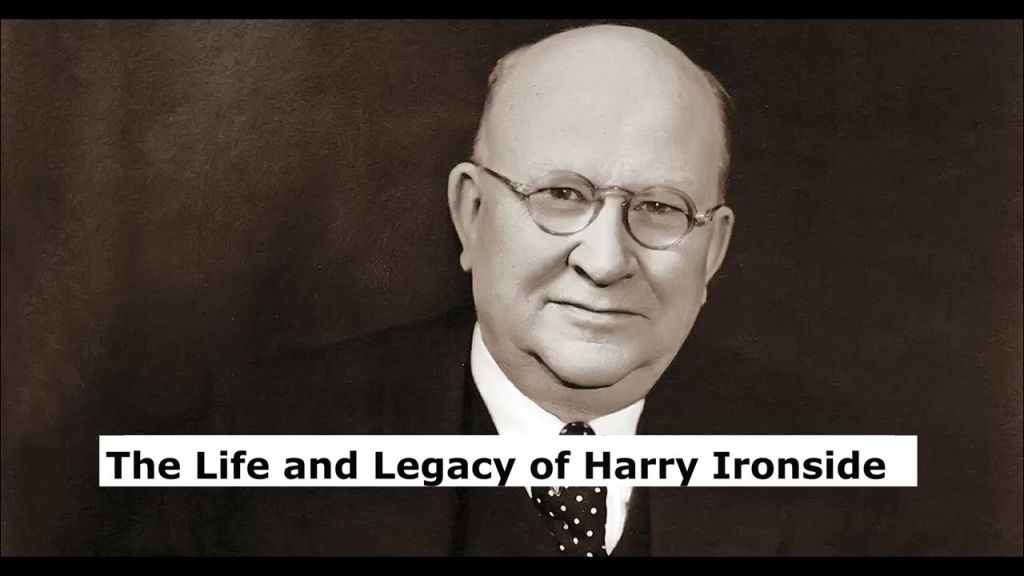
Ironside was born in Toronto, Ontario, to John and Sophia (Stafford) Ironside, both of whom were involved in the Plymouth Brethren. At the time of his birth, Harry was believed to be dead, leading the attending nurses to concentrate on Sophia, who was critically ill. It was only after 40 minutes when a pulse was finally detected in Harry that attempts were made to revive him. When Harry was just two years old, his father, John, passed away from typhoid at the age of 27. From a young age, Ironside exhibited a keen interest in evangelical Christianity and was active in the Salvation Army during his teenage years before eventually joining the “Grant” faction of the Plymouth Brethren.
The family relocated to Los Angeles, California, on December 12, 1886, and since there was no Sunday school available, young Harry took the initiative to start one of his own at the age of 11. He and his childhood friends collected old burlap sacks and stitched them together to create a tent made of burlap that could hold up to 100 people. As they could not find an adult teacher, Ironside took on the role himself, with the class regularly attracting around 60 children and a few adults each week.
In 1888, the famous evangelist Dwight L. Moody conducted a campaign in Los Angeles, holding meetings at Hazard’s Pavilion (later called “Temple Pavilion”), which had a capacity of up to 8,000 attendees. This experience inspired Ironside, who aspired to preach to similar large audiences one day. In 1889, after being influenced by evangelist Donald Munro, Ironside realized he was not “born again”, leading him to stop preaching at his Sunday school while he grappled with this spiritual issue for the next six months. Following a night of prayer in February 1890, at the age of 13, Ironside accepted Christ. He later reflected, “I relied on the Word of God and acknowledged Christ as my Savior.” He then resumed preaching and achieved his first conversion. Despite facing ridicule at school, he remained committed to his mission of saving souls. That same year, his mother married William D. Watson. Ironside completed eighth grade, took up a part-time job as a cobbler, and concluded that he had received sufficient education (not attending school again, a choice he would come to regret).
During the day, young Ironside worked at a photography studio full-time, and at night he delivered sermons at Salvation Army gatherings, earning the nickname “boy preacher.” At 16, he left the photography industry to fully dedicate himself to preaching within the Salvation Army. After being commissioned as a Lieutenant, Ironside quickly began delivering over 400 sermons annually throughout Southern California. However, by 18, the demanding schedule affected his health, prompting him to resign and seek recovery at the Beulah Rest Home. In 1896, at the age of 20, he relocated to San Francisco, reconnecting with the Plymouth Brethren. During this time, he aided British evangelist Henry Varley at his meetings and met pianist Helen Schofield, the daughter of a Presbyterian pastor from Oakland, California. The two soon married.
In 1898, Ironside’s mother passed away, and less than a year later, Harry and Helen welcomed their first son, Edmund Henry. In 1900, the family moved to Oakland, where Harry resumed his evening preaching schedule, and they lived there until 1929.
In 1903, Ironside received his first invitation to preach on the East Coast, but upon returning, his family only had enough money to reach Salt Lake City, Utah, where he spent the next ten days preaching on the streets. Just as their funds for a hotel were depleted, they received an anonymous envelope containing $15, which was sufficient for their return to Oakland. In 1905, they welcomed their second son, John Schofield Ironside.
During this period, Ironside also began his writing career, producing several pamphlets on Bible commentary. In 1914, he leased a storefront and founded the Western Book and Tract Company, which thrived until the economic downturn in the late 1920s. Between 1916 and 1929, he delivered nearly 7,000 sermons to more than 1.25 million listeners. In 1918, he worked alongside evangelist George McPherson, and in 1924, Ironside commenced preaching under the auspices of the Moody Bible Institute. In 1926, he received an offer for a full-time faculty position at the Dallas Theological Seminary, which he declined, although he served as a visiting lecturer there from 1925 to 1943.
After delivering a series of sermons at the Moody Church in Chicago, Ironside received an invitation in 1929 to take on a trial year as pastor. The next year, he was officially appointed as the pastor and held that position until 1948. He preached nearly every Sunday at Moody Church, often with the auditorium, which seats 4,000, completely filled. Ironside also preached in various cities across the United States and began traveling internationally in 1932. In 1938, he visited England, Scotland, and Ireland, where he preached 142 times to audiences of over 2,000. Additionally, in 1942, he became the president of the Africa Inland Mission organization. In 1935, he preached at Billy Sunday’s funeral at Moody Church.
In 1930, Wheaton College awarded Ironside an honorary Doctorate of Letters, and in 1942, Bob Jones University conferred upon him an honorary Doctor of Divinity degree.
A few months following the celebration of his golden wedding anniversary with his wife Helen, she passed away on May 1, 1948. Ironside stepped down as the pastor of Moody Church on May 30 and retired to Winona Lake, Indiana. He married Annie Turner Hightower from Thomaston, Georgia, on October 9, 1949. He faced issues with his eyesight, and after undergoing surgery to improve it, he began a preaching tour in New Zealand on November 2, 1950, again engaging with Brethren assemblies. However, he passed away in Cambridge, New Zealand, on January 15, 1951, and was laid to rest at Purewa Cemetery in Auckland.
Ironside never sought financial assistance for himself but was adept at fundraising for other evangelical initiatives and was frequently invited to lead offerings during Bible conferences. He humorously remarked that his gravestone would say, “And the beggar died also.”
Bob Jones Jr. noted that although Ironside was regarded as a man of dignity, those who got to know him found that “he had an amazing sense of humor. There was nothing more enjoyable than having a nice meal at home with Dr. Ironside around. Once he was full—he could eat a significant amount and consumed food faster than anyone I’ve ever seen, with his plate emptied before others were even served—he would lean back in his chair, move it away from the table, and start sharing amusing stories and personal anecdotes.” In 2011, Bob Jones University changed the name of a residence hall that previously honored Bibb Graves to recognize Ironside instead.
Beliefs
Soteriology
Ironside maintained that there is a significant distinction between the judgment seat of Christ and the great white throne judgment. He believed that Christians would be assessed for their eternal rewards at the judgment seat of Christ, but their good deeds would not influence their eternal salvation.
Ironside stated that the gospel is solely based on faith, dismissing the notion that baptism, turning away from sins, or yielding to Jesus constitutes the gospel. He asserted that having assurance of salvation is achievable, and it derives not from self-examination but by focusing on Christ’s work. He expressed that repentance in the New Testament signifies a straightforward change of mind, acting as a synonym for belief. He disagreed with the idea that repentance should be interpreted as a departure from sin.
Triadology
Ironside was a proponent of the doctrine of the Trinity, asserting that this belief is present in both the Old and New Testaments. In his commentary on Proverbs 8:22-36, he recognized the personification of wisdom as a reference to the second person of the Trinity, arguing that this passage refers to the eternal generation of the Son.
Dispensationalism
Ironside maintained that the church is parenthetical, a concept not disclosed in the Old Testament, and that at some point, God will rapture the church prior to the great tribulation, during which He will again turn His attention to the nation of Israel.
Harry Ironside identified as a dispensationalist but was highly critical of ultradispensationalism as presented by E. W. Bullinger. In his work Wrongly Dividing the Word of Truth, he evaluated ultradispensationalist views, including the notion that the church described in the book of Acts differs from the body of Christ, that the church did not begin until Paul’s imprisonment in Rome, and that Baptism and the Lord’s Supper are no longer relevant for Christians.
Theological Impact
Ironside was among the most prolific Christian authors of the 20th century, having published over 100 books, booklets, and pamphlets, many of which are still available today. One editorial reviewer remarked about a 2005 re-issue, stating, “Ironside’s commentaries are a standard and have endured the test of time.” Ironside also composed several hymns, one of which is titled “Overshadowed.”
Together with figures like Cyrus Scofield, he played a key role in making dispensationalism widely accepted among Protestants in North America. Even though he did not have formal schooling, his intellectual capabilities, exceptional memory, and passion for his convictions earned him the title “the Archbishop of Fundamentalism.”
Works of Harry A. Ironside
Commentaries
In canonical order
· Lectures on the Levitical Offerings (1929)
· Addresses on the Book of Joshua (1950)
· Notes on the Books of Ezra (1920)
· Notes on the Books of Nehemiah (1913)
· Notes on the Books of Esther (1905)
· Notes on the Books of Ezra, Nehemiah and Esther (Compilation 1951)
· Studies on Book One of the Psalms (1st edition 1952. Posthumous)
· Notes on the Book of Proverbs (1908)
· Addresses on the Song of Solomon (1933)
· Expository Notes on the Prophet Isaiah (1949)
· Notes on the Prophecy and Lamentations of Jeremiah (1906)
· Expository Notes on Ezekiel the Prophet (1949)
· Lectures on Daniel the Prophet (1st, 1911; 2nd, 1920)
· Notes on the Minor Prophets (1909)
· Expository Notes on the Gospel of Matthew (1948)
· Expository Notes on the Gospel of Mark (1948)
· Addresses on the Gospel of Luke (1947)
· Addresses on the Gospel of John (1942)
· Lectures on the Book of Acts (1943)
· Lectures on the Epistle to the Romans (1926)
· Addresses on the First Epistle to the Corinthians (1938)
· Addresses on the Second Epistle to the Corinthians (1939)
· Expository Messages on the Epistle to the Galatians (1942)
· In the Heavenlies: Practical Expository Addresses on the Epistle to the Ephesians (1937)
· Notes on the Epistle to the Philippians (1922)
· Lectures on the Epistle to the Colossians (1928)
· Addresses on the First and Second Epistles of Thessalonians (1947)
· Timothy, Titus and Philemon (1947)
· Studies in the Epistle to the Hebrews and the Epistle to Titus (1932)
· Expository Notes on the Epistles of James and Peter (1947)
· Addresses on the Epistles of John and an Exposition of the Epistle of Jude (1949)
· Lectures on the Book of Revelation (1919)
Books and booklets
In order by date of first publication
· Baptism: What Saith the Scriptures (1901, 2nd edition 1915)
· The Mysteries of God (1906)
· Sailing with Paul (1913: Loizeaux Bros, NY)
· The Four Hundred Silent Years (1914: Loizeaux Bros)
· The Midnight Cry (1914: Loizeaux Bros; 4th edition 1928)
· Letters to a Roman Catholic (1914: Loizeaux Bros)
· Good News from a Far Country: Ten Gospel Sermons (1934: Eerdmans) (Contributed chapter 5, titled “The Blood of His Cross”)
· Eternal Security of the Believer (1934: Loizeaux Bros)
· Things Seen and Heard in Bible Lands (1936: Loizeaux Bros)
· Except Ye Repent (1937: American Tract Society)
· The Crowning Day (1938)
· Help for the Needy Soul (1938)
· Wrongly Dividing the Word of Truth: Ultra-Dispensationalism Examined In The Light Of Holy Scripture (1938: 3rd edition, Loizeaux Bros) (A critique of the teachings of E. W. Bullinger and hyperdispensationalism)
· Random Reminiscences from Fifty Years of Ministry (1939)
· Changed by Beholding: and other sermons (1940)
· The Way of Peace (1940)
· A Historical Sketch of the Brethren Movement (1941: Loizeaux Bros)
· Not Wrath but Rapture (1941: Loizeaux Bros)
· The Continual Burnt Offering (1941: Jubilee Edition, Loizeaux Bros)
· The Great Parenthesis (1943: Zondervan, Grand Rapids, MI; 2014, 2016, 2017)
· Holiness: The False and the True (1947: Loizeaux Bros)
Pamphlets and tracts
· “The Mormon Mistake” (1896)
· “The Stone that Will Fall from Heaven” (nd)




Leave a comment