
Introduction
Thomas Newberry (1811-1901) was an English Bible scholar and writer, best known for producing what is usually called The Englishman’s Bible, now more often the Newberry Study Bible or Newberry Reference Bible.
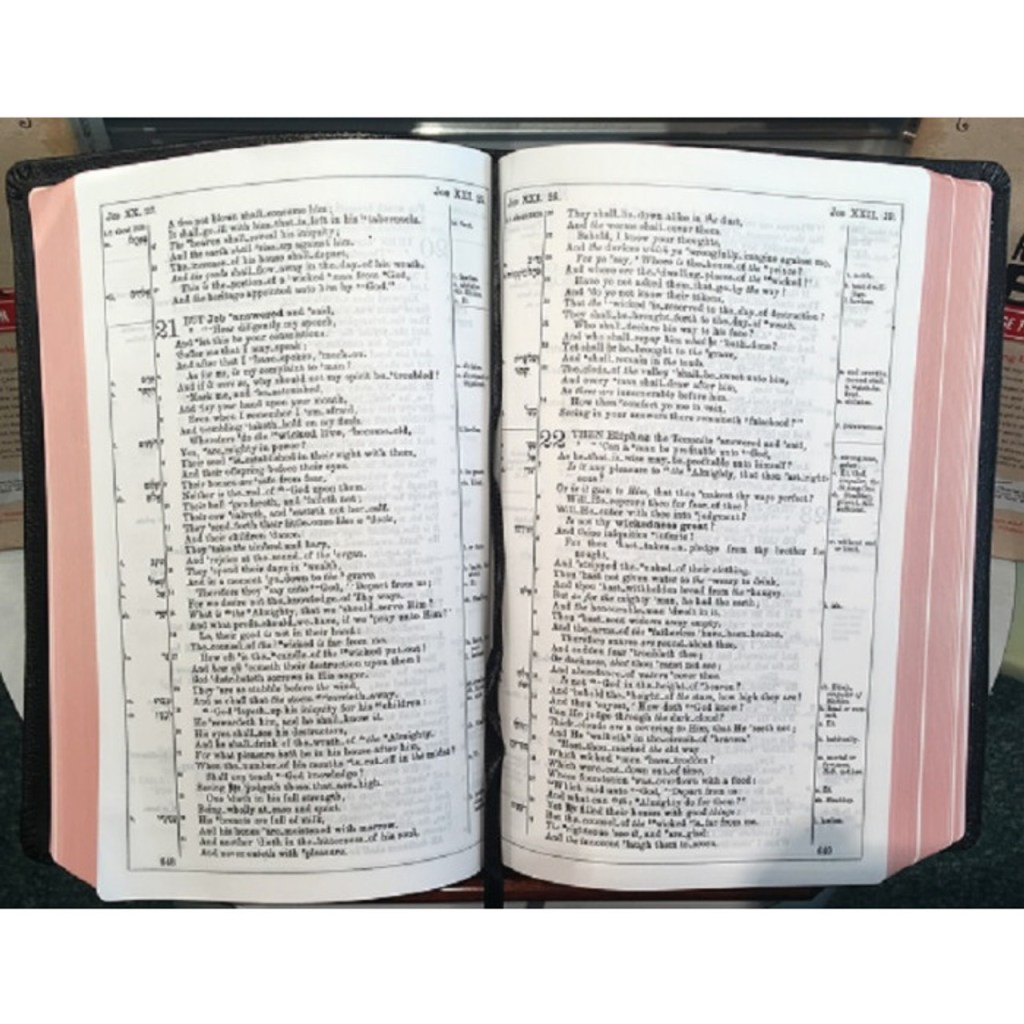
His purpose was to provide English-speaking readers with a Bible that preserves as much as possible the accuracy, precision, and certainty of the original Hebrew and Greek texts, by means of annotations, signs, and marginal notes, while still using the Authorized Version (King James Version) as the basis of the English text.
Biography (Brief)
To understand why Newberry created his Study Bible, a short outline of his life:
- Born in 1810 or 1811, into a Christian home in England; from childhood he had been familiar with scripture.
- Around 1840 he resolved to read the Scriptures in their original languages: Hebrew for the Old Testament, Greek for the New Testament. This deepened his conviction about the importance of textual precision.
- He was associated with the Plymouth Brethren (a Christian movement emphasising the authority of the Bible, simplicity of worship, and the priesthood of all believers). Surrounded by other serious Bible expositors and teachers, he devoted himself to study, both original languages and the variants of the manuscripts.
- In 1863, he was given a copy of Tischendorf’s transcription of the New Testament according to Codex Sinaiticus, which he annotated heavily. Two years later he began work on what became The Englishman’s Bible.
What is the Newberry Bible (“Englishman’s Bible” / “Newberry Study/Reference Bible”)
Purpose & Distinctive Aim
The aim of the Newberry Bible is:
- To bring out, for English readers, features in the original Hebrew and Greek texts — things like differences in tense, mood, emphatic pronouns, prepositions, numbers. Features that often don’t come through in translation.
- To do this without replacing the English Authorized Version (KJV), but overlaying it with signs and marks and marginal notes that help the reader see what the original languages say.
- To make the Bible more “self-explanatory” to someone who does not know Hebrew or Greek, by pointing out variant manuscript readings, alternative translations, grammatical or syntactical features, etc.
Editions & Format
Over time, The Englishman’s Bible / Newberry Reference Bible has been issued in several editions and formats. Key points:
| Edition | Format / Size / Notable Features | Approx Date |
| “Portable” edition, two-column | more compact format for personal use | 1875 |
| “Large print” / single-column edition | easier reading, one column per page, more room for notes and layout | ~1890 |
| Pocket edition | verse-format, smaller size for portability |
The Bible has also been reprinted in modern times — e.g. single-column leather editions; pocket editions; reference/study versions.
Features / Markings
Here are the distinctive features that make the Newberry Bible unique:
- Signs / symbols in the text to indicate grammatical features: tense, mood, prepositions, emphatic pronouns etc. These help reveal features in the Hebrew or Greek which are not obvious in the English translation.
- Alternative renderings (marginal notes) giving literal or variant translations of Hebrew or Greek words/phrases.
- Critical apparatus / manuscript variant notes, especially in the New Testament: footnotes indicating variant readings from different manuscripts.
- Divine titles (God-names) distinguished and explained. The titles for deity in Hebrew and Greek are often marked in the margin or otherwise highlighted.
- Old Testament quotations in the New Testament are printed in uppercase / capitals to show they are quotations.
- A chart of weights, measures and coins; a chart of Greek prepositions; other helps designed to aid comprehension of background and textual detail.
- Layout features: single-column versions; poetic passages laid out distinctively; parallel passages indicated in margins; a “lower hyphen” connecting several English words where the original had but one word.
Strengths and Criticisms
Strengths
- Bridges the gap for non-specialists: For those who have no formal training in Hebrew or Greek, the Newberry Bible provides many of the insights you would get from learning the languages, through its signs and notes.
- Textual sensitivity: Newberry was very attentive to manuscript variants and original language nuances. It encourages readers to appreciate the precision of the biblical text.
- Consistency with the KJV: For those who prefer the traditional Authorized Version, he does not discard it, but enhances it, thereby preserving its reverence and familiar language while supplying insight.
- Durable physical editions: The newer editions are often well bound, single-column leather, making them good for frequent use.
Criticisms or Limitations
- Learning curve: Because of all the signs, symbols, marginal notes etc., it takes some time for a reader to become fluent in using the Newberry study aids. If someone doesn’t take time to learn what each sign means, many of the annotations may be confusing.
- Dependence on KJV textual base: It inherits all the benefits and limitations of the KJV: archaic language, the specific manuscript base used in the Authorized Version, etc. For readers interested in modern translations using newer critical text editions, the styling might feel restrictive.
- Limited theological or interpretative commentary: The emphasis is on textual, grammatical, and translation variants rather than extensive theological exposition. For deep doctrinal or devotional notes, one would need to supplement with other commentaries.
Legacy and Impact
- The Newberry Bible is held in high regard among serious students of the Bible, especially those committed to the KJV/Authorized Version.
- It has been used to help readers see the richness of the original languages without mastering them fully, thus affecting many whose primary language is English only.
- Scholars such as F. F. Bruce have praised Newberry’s work for its unpretentiousness and fidelity, noting that he “had no axe to grind … one aim was to make the fruit of his study available …”
- The Bible remains in print in various editions today, showing continuing demand. Publishers like John Ritchie Ltd and Kregel publish modern versions.
How to Use the Newberry Bible Effectively
If one is using or considering using the Newberry for study, here are some tips:
- Learn the key symbols/signs: Spend time with the introductory chart (“Signs Employed” etc.) in the front of the Bible to understand what each mark means (tense, mood, emphatic pronoun etc.). Without that, much of the added value is hidden.
- Use the margin-notes and alternative renderings when studying a passage: compare how a Hebrew or Greek phrase might be literally translated vs how the KJV has done it. This can reveal shades of meaning.
- Check footnotes for variant readings to see where manuscripts differ. This helps in understanding textual uncertainty, and in some cases, theological implications.
- Cross-reference quotations: Old Testament passages quoted in the New Testament are capitalized — this helps track fulfilment, echo, allusion.
- Compare with modern translations or original language tools: While Newberry enables insight without needing Hebrew/Greek fluency, pairing with strong modern translations or lexicons will deepen understanding.
Conclusion
The Newberry Bible is a study Bible with a specific and worthy goal: preserving and showing as much of the original Hebrew and Greek textual and linguistic detail as possible, while retaining the beauty and heritage of the King James / Authorized Version. It is especially suited for those who love the KJV but also want insight into what lies under the translation — its original grammar, manuscript variants, and more. Though it requires effort to learn its system of signs and notes, those who persevere often find it richly rewarding.





Leave a comment