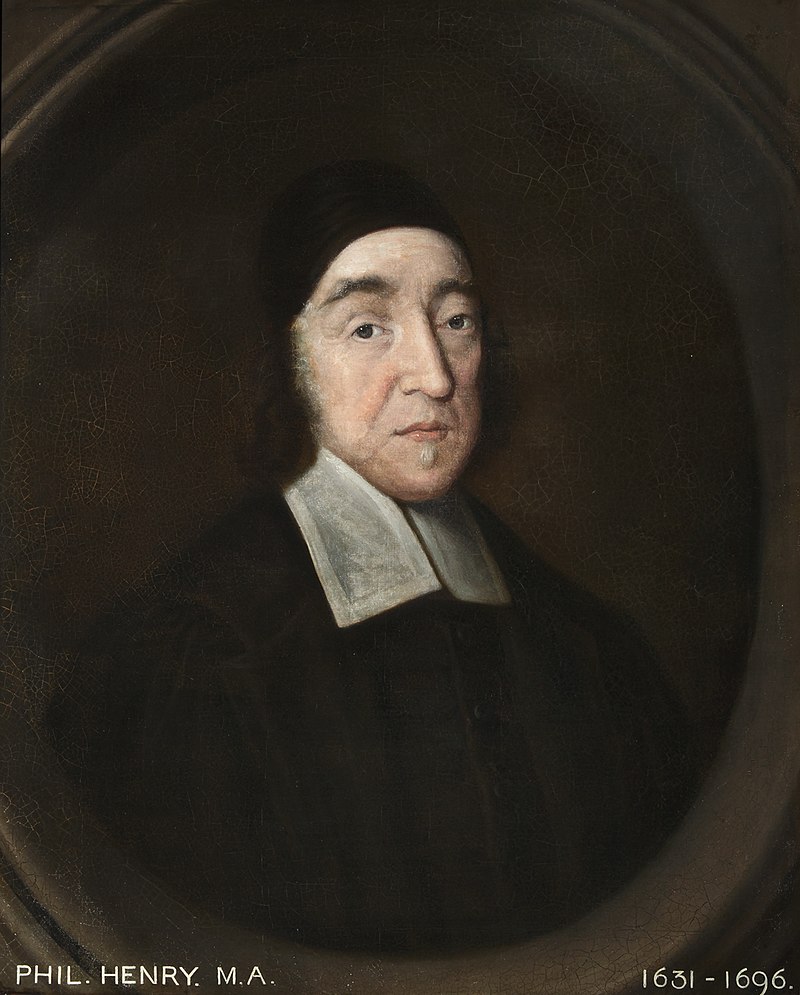
Philip Henry (24 August 1631 – 24 June 1696) was a Nonconformist minister and diarist from England. His son, Matthew Henry, gained recognition as a significant Bible commentator and served as a Presbyterian pastor.
Philip Henry was born on August 24, 1631, in Whitehall, London, and was named after Philip Herbert, the 4th Earl of Pembroke, who was served by his father, John Henry. Philip Henry was the firstborn of John Henry, who was the orchard keeper at Whitehall Palace. The role of his father as a courtier ensured a steady income for the family. His mother’s name was Magdalen Rochdale.
As a young boy, he was friends with princes Charles II and James II, and he cherished a book given to him by James II until his death. Archbishop William Laud recognized him for his promptness in opening the watergate when Laud arrived late from the council to travel by boat to Lambeth. His father brought Philip Henry to visit Laud while he was later incarcerated in the Tower of London.
He initially enrolled in a Latin school at St. Martin’s Church before moving to Battersey. In 1643, at the age of 12, he was accepted into Westminster School and became a King’s Scholar in October 1645. During his time there, he studied Greek and Latin and was known for quoting classical writers in discussions. He was a favored student of Richard Busby. At the beginning of the English Civil War, clergy members held a series of morning lectures at Westminster Abbey, and his mother, a Puritan, arranged for him to attend these early sessions. Henry attributes his preparation for holy communion to Richard Busby’s dedication. He credits his choice to lead a religious life in April 1647 to the influence of Stephen Marshal at St. Martin’s.
In May 1647, Henry was chosen for a studentship at Christ Church, Oxford, and took up residence on December 15. He was officially admitted as a student on March 24, 1648, shortly before the parliamentary visit that replaced his tutor, Underwood, with William Finmore (who later became the archdeacon of Chester). He earned his B.A. in 1650/1 and M.A. on December 10, 1652.
During his leave at home in January 1649, he witnessed Charles I traveling by boat from Whitehall to Westminster each day for his trial, and he spoke to his father on one occasion. He provided a firsthand account of Charles’s execution, stating, “[I] can honestly express with a heavy heart…there was such a groan from the thousands present that I have never heard before and hope to never hear again.” The death of his father resulted in financial struggles for the family.
He wed Katharine Mathews (25 March 1629 – 25 May 1707) on 26 April 1660, at Whitewell Chapel. Katharine was the sole offspring of Daniel Matthews from Bronington and Broad Oak in Flintshire. The pair had six children: John Henry (3 May 1661 – 12 April 1667), Matthew Henry, Sarah Henry, Katharine, Eleanor, and Ann Henry (born in 1667). The oldest daughter, Sarah, who was married to John Savage, maintained a diary that was eventually published.

Leave a comment