Introduction
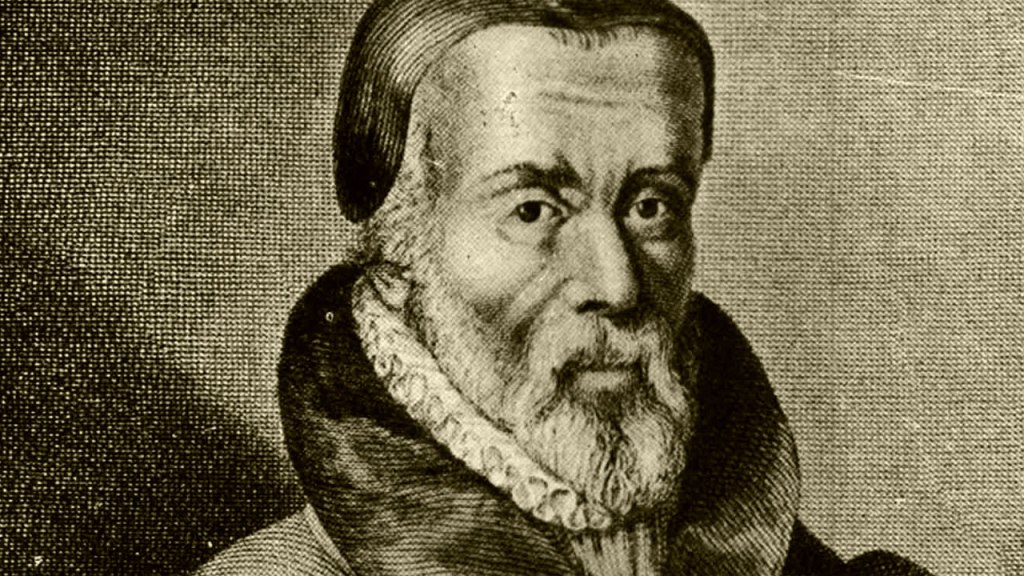
Tied to a pole, wood piled around him, and burnt to death for translating the Bible into English. William Tyndale has been written out of history and largely forgotten. No one has changed our language more than Tyndale, he changed Christianity not just in England but throughout the English-speaking world.
Born in the heart of England in the hills of the Welsh border, growing up Tyndale was taught his only purpose in this life was to seek salvation in the next. During Tyndale’s time of life, England was a strongly Roman Catholic country, and people who disagreed with the teachings and practices of the Catholic Church were considered heretics and not worthy to be a citizen of England. The language of the Church and its Bible was Latin, which was beyond most people’s understanding and comprehension as they all spoke English.
This was great for the Catholic Church and the King of England because this meant that they had control over Scripture. The common people could not read the Bible, and they could not challenge the King’s policies and the rulings of the Church.
Purgatory, Confession, and the Catholic hierarchy are not in the Bible but passed on down the line of Popes, this is known as Canon Law. In 16th Century England, even attempting to translate the Bible was illegal and was punishable by the death sentence.
Growing up Tyndale dreamed about an English translation of the Holy text, so the common man could understand and read God’s word for himself. He risked his life for this dream to become a reality.
Education
Oxford, Spring 1506
Magdalene Hall was one of the best education establishments in Europe. Tyndale arrived there when he was just 12 years old and stayed for 8 years to work toward his B.A. which he achieved. The B.A. allowed him to study theology, but the official course did not include the direct study of Scripture.
Tyndale later complained: “They have ordained that no man shall look on the Scripture until he is no sold in heathen learning eight or nine years and armed with false principles, with which he is clean shut out of the understanding of the Scripture.”
Tyndale was at college when he started to study and read the Bible. Tyndale discovered the great Dutch theologian Erasmus. Erasmus believed, to get to the truth of a text you must study the text in the original language it was written in. In the case of the New Testament this is Greek and for the Old Testament, Hebrew. This got Tyndale thinking about the pure translation of the New Testament. Tyndale was not going to use the current Latin Bible, but the Greek. When translating from Latin into English the meaning of the sense can be lost and does not read well. Tyndale realised that if his translation was going to be accurate, he would have to use the Greek text.
Justified by Faith
Just like Martin Luther, Tyndale strongly believed that Christians are justified by faith (Romans 5:1). The Catholic Church does not hold the key to salvation and heaven, Tyndale believed that the individual has the choice of being saved, not through the church. As it is written in Ephesians 2: 8-9, “you are saved by grace and through faith, not of yourselves, it is God’s gift to the believer and not as a result of good works.” Tyndale and Luther believed that salvation does exist outside the Catholic Church. As Greek Christians and the early church were not Catholics.
If Tyndale and Luther were right there was no need for the church structure of confession, pilgrimages, penance, riches, and sacraments – by which salvation is sought.
Little Sodbury,
Gloucestershire, 1522
After Oxford, Tyndale was ordained as a priest. When he was Tutor and Chaplin to the family of John Walsh his beliefs caused a few problems. During dinner, a priest said, it would be better to be without God’s laws than the Pope’s. As you could imagine this angered Tyndale and they must have had a heated debate. The priest was promoting the word of the Pope over God and Scripture, thus claiming to be without the Pope’s law and teachings are far worse than being without God’s Word and commandments.
The Bible is the Word of God. The main purpose of having the Bible here on earth is to read the Word of God and to listen to the Word of God. Scripture is also to be accessible and read in a language understandable, so that the truth of God may be known.
London 1523
In 1523 Tyndale went to London as he knew his days in Gloucestershire were numbered. He asked Bishop Tunstall to help him with his English translations, but Tunstall refused point-blank. By this time Tyndale knew that he was never going to find success in England, so in 1524 he left London for Hamburg, Germany, the home of Martin Luther as he believed he may be more successful in Germany and could work on his English New Testament.
Cologne Germany, 1525
Known for its prolific printing presses Tyndale headed for Cologne, in search for someone to print his English New Testament. However, Cologne was a Catholic city and most of the printing presses were owned and controlled by the Archbishop. After searching for a printer that agreed to take a chance on Tyndale, he managed to print 3,000 copies of Tyndale’s New Testament, which made their way to the shores of England. This was a great breakthrough for Tyndale, and he took every opportunity by hiding the pages of the New Testament in other books, hiding completed English New Testaments in boxes, bottles, clothing, and other means.
To be found in possession of an English New Testament was harshly punished, so the book had to be small enough to hide or fit in a coat pocket. By God’s providence, Tyndale’s New Testament flooded England with the truth.
Tyndale’s translation and impact on the English language
When Tyndale was writing his English New Testament from Greek. He changed some of the Greek words for example ‘Ekklesia’, the Greek word for Church, Tyndale wrote “congregation.” To Tyndale ‘church’ meant the Catholic hierarchy and authorities, all of which Tyndale detested. On the other hand, the congregation meant a collection of people worshipping God or an assembly of believers.
Another word Tyndale altered was the Greek word ‘presbyters’ which in English means “Priest.” For Tyndale, the word Priest sent out the wrong message, as they often interred with people and were appointed by the church, rarely by God. By removing ‘priest’ Tyndale was striping the hierarchy of the Catholic establishment. Tyndale wanted to tell people, that you submit to God and not your Priest. The word “Elder” or “Overseer” is a much more accurate rendering of the Greek.
Some of Tyndale’s words and phrases that we still use today.
● A law unto themselves
● A moment in time
● Be not weary in well-doing
● Ask and it shall be given you
● Eat, drink and be merry
● Fashion, not yourselves to the world
● Fight the good fight
● Filthy lucre
● Gave up the ghost
● It came to pass
● Judge not that you not be judged
● Knock and it shall be opened unto you
● Lead us not into temptation but deliver us from evil
● Let there be light
● Live and move and have our being
● My brother’s keeper
● Scales fell from his eyes
● Seek and you shall find
● The patience of Job
● The powers that be
● The salt of the earth
● The signs of the times
● The spirit is willing, but the flesh is weak
● The word of God which liveth and lasteth forever
● They made light of it
● Twinkling of an eye
William Tyndale is the founder of modern English prose and without Tyndale works such as Shakespeare would never have existed and other national gems such as Wordsworth and Milton. Tyndale is in many ways the Father of the modern English Bible. Many other publishers and translators have followed Tyndale’s ethos and vision to have God’s Word available in a language and style readable, understandable and meaningful. Also true to the Greek and Hebrew. When translating the English Standard Version, the members of the translation team drew inspiration from Tyndale to allow even the ploughboy to grasp the Scriptures.
London 1526
By 1526 many of Tyndale’s New Testaments were pouring into England. However, this was not a great success as word got to the authorities and 2,000 copies of Tyndale’s New Testament were brought to St Paul’s Cathedral, London. It was said at the time, that there were over 1,500 errors in translation, so the works were brought outside the Cathedral grounds and burnt. Bishop Tunstall organised it himself. I am sure you can work it out for yourselves the real reason for burning the work. I believe that the Papists read the work and knew that Tyndale was right, and the Catholic Church began to worry. An eyewitness said that on that day the Bishop did not preach the Word of God but burnt it.
Hever Castle, Kent 1528
King of England, Henry VIII met his second wife Anne Boleyn at Hever Castle in Kent, South England. Henry wanted a divorce from his first wife Catherine of Aragon. This was based on the Bible verse in Leviticus, which states a man must not marry his brother’s wife. Catherine was the widow of Henry’s brother, Arthur. King Henry applied to the Pope in Rome for his wishes to be granted. The Pope refused.
Help came from an unexpected source, William Tyndale. A copy of The Obedience of a Christian Man, found itself in the hands of King Henry. Tyndale published this book in 1528. In the book, Tyndale outlines the supremacy of Scripture over any authority even the Pope himself. God appoints Kings, which means that Kings are the highest authority in the land, and Popes are elected, by men. This pleased the King tremendously.
Tyndale also pointed out that there are other verses in Scripture such as Deuteronomy 25:5 that may not support Henry’s claim of a just reason for divorce. “If brethren dwell together, and one of them die, and have no child, the wife of the dead shall not marry without unto a stranger: her husband’s brother shall go in unto her, and take her to him to wife, and perform the duty of a husband’s brother unto her”, reads Deuteronomy 25:5.
Tyndale returns to Antwerp 1530
The King’s new secretary, Thomas Cromwell sent an agent to meet Tyndale to persuade him to return to England. For the first time in 6 long years, Tyndale broke his cover and met with the royal agent. The two men met up several times, but Tyndale stood his ground and refused to return to England as he feared he would be called a heretic and burnt. After a while, Tyndale did agree to come back, but on the condition that the King agreed to have an English Bible in England. Henry did not allow Tyndale’s condition.
Westminster 1531
Back in London, Henry was losing his patience with the Pope over his marriage annulment. King Henry addressed his parliament and demanded he become head of the Church in England. The Church of England also known as Anglicanism was born. King Henry held the title of soul protector of the church and clergy, alongside defender of the faith. The latter title Henry already held which was granted to him previously by the Pope.
For Tyndale this should have been a great moment of triumph, Henry rejected the authority of the Pope and Rome. But the king did not recant his Roman Catholic beliefs and most importantly he still wanted the Bible to remain in Latin. Henry’s new English Church remain Catholic at heart. Henry had Roman Catholicism in England, but without the Pope. In 1533 Henry’s marriage to Catherine was declared null and void, in the same year, he married his mistress, Anne Boleyn.
Antwerp 1535
A new threat to Tyndale was from the Pope. Antwerp was under the power of the Holy Roman Emperor, Charles V. Local Catholics wanted the area to be searched and cleansed from all “heretics.” In 1535 Tyndale befriended a new arrival, Harry Phillips. Phillips seemed to show interest in Tyndale and share many of his beliefs. Phillips was an Oxford graduate and Tyndale got on well with him. Over time the friendship grew.
However, Phillips was not what Tyndale thought he was. Tyndale was not aware that his friend studied at a strict Catholic university and was in talks with the Catholics about Tyndale’s arrest. Phillips was indeed a Catholic and not sympathetic to Tyndale, he was to betray him. Phillips became Tyndale’s very own Judas.
On May 21, Phillips called on Tyndale and told him he had no money. Tyndale took him out to dinner. On the way, Phillips insisted that Tyndale walked in front of him. The two men walked down a small alley at the bottom of the street where two armed men of Charles V were in waiting to arrest Tyndale.
On October 6, 1536, Tyndale was led from his cell to his painful execution by being burnt alive. As an act of mercy, they strangled Tyndale before they lit the fire. Tyndale’s last words were, ‘Lord, open the King of England’s eyes. In Tyndale’s day, people were burnt because it was believed by burning the body they also burnt the chances of the soul going to heaven and meeting God.
Tyndale died before he could translate all of the Holy Bible into English, but he has done enough. The New Testament, the first 5 books of the Old Testament, and a few other Old Testament books were completed. Ironically an English Bible did appear in England, commissioned by Thomas Cromwell and its patron was King Henry VIII himself.
How Tyndale impacted the King James Bible
Over 84% of the New Testament in the King James Bible was written by William Tyndale. The King James translators based their translation on Tyndale’s work. When we read the New Testament in the King James, we are reading mostly Tyndale’s words. 74% of the first 5 books (Pentateuch) were written by Tyndale. So, you could say that the King James Bible is mostly Tyndale’s Bible.
Not many memorials to Tyndale stand today. There are a few, but not many. However, his greatest memorial is one of the world’s bestselling books. William Tyndale left a priceless gift to England. God used Tyndale to speak to people and to save many souls in the English-speaking world. Tyndale gave his life to the liberation of the English people by causing them to think about God and spiritual matters. He profoundly changed the English language and the world forever. May we all thank God for sharing William Tyndale with us.
Only one completed first edition is known to exist, which was purchased by the British Museum. The Museum said it is, “the most important printed book in the English language.” The book was sold for a little over a million pounds.
Why we should remember William Tyndale
Without Tyndale, the works of Shakespeare and other literary giants would never have existed. Tyndale is not just a great man of history who dedicated his life to an English translation of the Bible, he is also a great Englishman. In 2002 William Tyndale was placed at number 26 out of 100 on the BBC’s poll of great Britons, not bad for someone who most people in the United Kingdom have never heard of. Tyndale was placed higher than footballer, David Beckham, and writer, Charles Dickens. Tyndale’s legacy can still be seen today. Tyndale is still with us, his many English phrases are still used, even though he died over 500 years ago.
Thanks to the amazing work God did through Tyndale England and all English-speaking people have a copy of God’s word in a language and style they could understand. It would be fair to say that Tyndale was the most dangerous man in Tudor England, as the translation of God’s Word into English made it possible for common people to read and understand God’s power, grace, mercy, and love. The power that was unleashed throughout England via the Tyndale New Testament was tremendous, the effect of which can still be seen today.
Try to put yourself in the situation many would have been in during Tyndale’s day. Imagine life without the Bible in English. Imagine having to depend on the Priest to tell you what the Bible says. Imagine not being able to check if the words of the “Church” are or are not in keeping with Scripture. That was the reality for many in England. Living according to what a Priest tells you, putting your trust in the “Church” and hoping that you have done enough to gain heaven in the next life. Also knowing that the Bible is God’s revealed truth to mankind and not being allowed to read it for yourself, for fear of death.
It must have been an overwhelming experience just to hold a copy of Tyndale’s New Testament. What an amazing blessing to read the Word of God in English and learn the doctrines of Christ for the first time.
Tyndale is one of few who has made an impact on the nation long after his death. His Influence on England and English-speaking people is so profound, yet many would not know who Tyndale is. This is one of many reasons why the life of Tyndale and his many works and writings ought to be celebrated, remembered, and cherished. Ask yourself this, when was the last time you read a book that someone risked their life to render into your language?
William Tyndale is a hero of the faith. He was a man with a passion for the truth, courage to go against the tide, and man of outstanding and steadfast faith in Christ. For many Tyndale represents boldness in the face of adversary and persecution. Tyndale was willing to die so that the common man could read the Bible. He regarded the translation of God’s Word far more valuable and worthy than his own life.
If there is a Bible verse that sums up the life of William Tyndale it is Philippians 1:21, “For me to live is Christ, and to die is gain.” Tyndale did not just believe that, he lived it out.
“The grass withers, the flower fades, but the word of our God will stand forever.”
Isaiah 40:8



Leave a comment