Overview
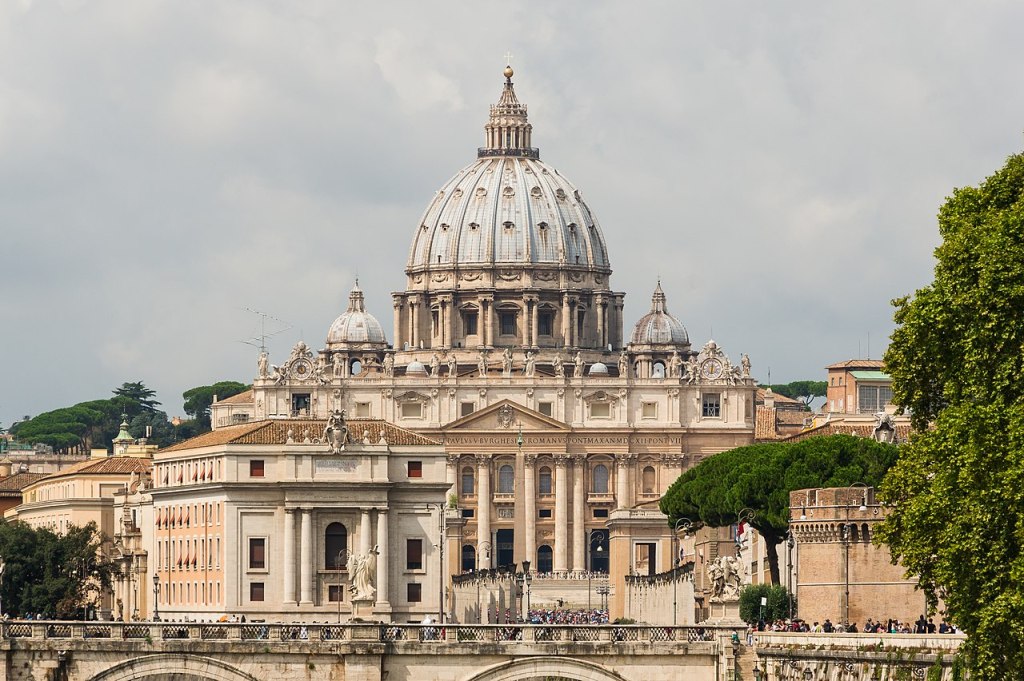
Rome, Italy the headquarters of the Roman Catholic church, the city that is built on seven hills (Aventine, Caelian, Capitoline, Esquiline, Palatine, Quirinal, and Viminal). There are about 1.3 billion Catholics worldwide. The Roman Catholic church has over 5,300 bishops, over 415,000 priests, and over 45,000 deacons. Catholicism is one of the largest religions in the world.
Catholicism came into being unofficially in 312 A.D. When Constantine became the Roman Emperor, he converted to Christianity. The Pope of Rome inherited Constantine’s title as the head of the church, “Summus Pontifex.” The Roman Catholic church is the oldest institution in Western civilization.
Roman Catholics believe that the Pope is the head of the church and the successor of St. Peter, who is believed to have been the first Pope by Roman Catholics.
Catholicism has had a somewhat rocky history in the United Kingdom. At one point in Britain Catholicism was the state religion and at another time was illegal to practice on British soil. In the 1530s King Henry VIII of England broke from Rome and created the Church of England. He made himself the head of the church in England and set on a course to rid England of papal superstition, corruption, and popery. King Henry VIII destroyed religious houses such as monasteries and made a vast wealth from the raids of such places.
In the early 17th century Catholics were treated as second-class citizens in their own country. An attempt to restore the Catholic faith to England was made in November 1605. The Gunpowder Plot of Guy Fawkes was to be England’s 9/11. The plan was not successful. The plot was discovered, and danger was adverted. If successful, the gunpowder plot would have destroyed most of London as we know it today. The Palace of Westminster, Westminster Abbey, and most of central London would have been devastated by the blast. A great fireball would have engulfed London.
In 1698 the Popery Act of Parliament was passed. This legislation was an attempt to address the issue of the growing number of Roman Catholics in England and Wales. The document ensured that anti-Catholic laws were more strongly applied. The act stated that anyone who was caught affirming their loyalty to the Bishop of Rome would be subject to punishment and anyone caught saying the Catholic Mass would receive a fine of £100, which in today’s value is about £10,600. By the 19th century hostility to Catholicism started to die down. Catholics started to have civil rights in 1829.
The Roman Catholic church prides itself on being the only legitimate Christian church on earth. This is a bold statement by Catholicism. In this booklet, I aim to put these claims to the test. If Catholicism is the only true church, then we should have no problem proving that from the text of Scripture. I would like to present the teachings of Catholicism in comparison to the Bible.
Many doctrines of Catholicism have been disputed and debated over for many years. The Protestant Reformation was started as a result of Rome’s doctrines and claims. Sadly, many of these contentions resulted in very sinful behaviour.
Many books and articles have been written on the various subjects that Catholics and Protestants have debated. The main book that I will quote from, and use will be the Catechism of the Catholic Church, references to such will be indicated by “CCC.”
Most Roman Catholics would view themselves as Christians. Sadly, many Catholic people are unaware of the major differences between what their church teaches and what the Bible says. The Catholic church discourages personal Bible reading and study.
This means that many members of the Catholic Church are completely dependent on the church to teach them doctrine, which is often not from the Scriptures but from the various documents produced by the Church of Rome.
A Timeline of Catholicism’s Unbiblical Practices
Below is a list of the many doctrines, teachings, and practices of Roman Catholicism that are not found in the Bible but are the inventions of men.
1. Prayers for the dead introduced – 300 A.D.
2. Making the sign of the cross – 300 A.D.
3. Worship of angels & dead saints – 375 A.D.
4. Use of graven images in worship – 375 A D.
5. The Mass as a daily celebration – 394 A.D.
6. The term, “Mother of God” applied to Mary at the Council of Ephesus – 431 A.D.
7. Last Rites, the last prayer of those who are close to death – 526 A.D.
8. Prayers to Mary and other dead saints of Catholicism – 600 A.D.
9. Fasting on Fridays during Lent was created – 998 A.D.
10. Celibacy of priesthood – 1079 A.D.
11. The Rosary Beads – 1090 A.D.
12. The sale of Indulgences – 1190 A.D.
13. Transubstantiation, the doctrine that teaches that the elements of the Lord’s Supper change into the divinity of Christ, by the consecration of the bread and wine they change into the actual body and blood of Christ. The bread into his body and the wine into his blood. Introduced by Pope Innocent III – in 1215 A.D. Also worth noting that Pope Innocent III taught that there is no salvation outside the Church of Rome. He said, “There is but one universal Church of the faithful, outside which no one at all is saved.” (Fourth Lateran Council, 1215.)
14. The Confessing of sins to a Priest – 1215 A.D.
15. Purgatory was proclaimed as an official doctrine of Rome. Also known as Final Purification where those who die to undergo purification to achieve the holiness necessary to enter the Kingdom of God. This doctrine of Purgatory was invented by Pope Gregory I in 593 A.D. but not officially adopted until 1439 A.D.
16. The doctrine of the Seven Sacraments is confirmed. Which is Baptism, Confirmation, Eucharist, Penance, anointing of the sick, Holy Orders, and Marriage – 1439 A.D.
17. Church tradition was declared to be of equal authority with the Bible by the Council of Trent – 1545 A.D.
18. Pronounced 125 anathemas (eternal damnation) upon all those who believe and profess Evangelical Christianity.
19. Equal value and authority of tradition and Scripture (in actuality, tradition is held above Scripture).
20. Apocryphal books added to the Canon of Scripture at the Council of Trent – 1546 A.D.
21. Immaculate Conception of Mary decreed by Pope Pius IX. The doctrine that Mary did not inherit the sinful nature of Adam and Eve, thus she remained her whole life without sin. – 1854 A.D.
22. The infallibility of the Pope in matters of faith and morals was established at the First Vatican Council – 1870 A.D.
23. The Assumption of Mary. The teaching that Mary had no corruptions of her body and bodily ascension into heaven shortly after her death – 1950 A.D.
All of the 23 points above are official Roman Catholic teachings according to the Catechism of Catholicism. These doctrines are by no means secondary issues that Protestants and Catholics can agree to disagree on and remain in fellowship and even worship together. The false doctrines listed above attack the very heart of the Christian faith and Gospel. Fundamentally the teachings of Rome are based on the so-called authority of the Pope (Bishop of Rome) and not the Word of God, the Holy Bible. You will be stretched to find any of these teachings in the Bible. You will not find any Scripture to prove these 23 points of Roman Catholicism.
The Protestant Reformation which started on October 31st, 1517 was a blessing and was much needed. In the United Kingdom, the state Church also known as the Established Church is the Anglian Church also known as the Church of England. You will be forgiven for thinking that the Anglican Church is not protestant, as the modern-day Church of England does not appear to be Protestant at all. The 39 Articles of Religion which are still the legal and official teachings of the “Protestant” Church of England have much to say about the Romanish doctrines listed above.
Take for example Article XI of the justification of man, “We are accounted righteous before God, only for the merit of our Lord and Saviour Jesus Christ by Faith, and not for our own works or deservings: Wherefore, that we are justified by Faith only is a most wholesome Doctrine, and very full of comfort, as more largely is expressed in the Homily of Justification.”
Article XXII of Purgatory which reads, “The Romish Doctrine concerning Purgatory, Pardons, Worshipping, and Adoration, as well of Images as of Reliques, and also invocation of Saints, is a fond thing vainly invented, and grounded upon no warranty of Scripture, but rather repugnant to the Word of God.”
If these two are not clear enough maybe Article XXXI of the one Oblation of Christ finished upon the Cross will convince you of the Protestant roots and nature of the Church of England, “The Offering of Christ once made is that perfect redemption, propitiation, and satisfaction, for all the sins of the whole world, both original and actual; and there is none other satisfaction for sin, but that alone. Wherefore the sacrifices of Masses, in the which it was commonly said, that the Priest did offer Christ for the quick and the dead, to have remission of pain or guilt, were blasphemous fables, and dangerous deceits.”
The reason why I have quoted the Articles of Religion is this. On October 31st, 2017 a service was held at Westminster Abbey, which marked 500 years to the day that Martin Luther nailed his famous 95 theses to the Church door of Wittenberg, Germany. In January of the same year, a statement was published by the Archbishops of Canterbury and York who are the most senior clergymen in the Church of England.
One Anglican news headline at the time read, “Lutherans, Catholics, Methodists, Reformed, and Anglicans drew into deeper communion”
There were some very good points made such as the “clear proclamation of the gospel of grace” and the fact that a main principle of the Reformation was to make the Bible available in “their own language.”
However, there were some parts of the statement that sought to undo a very important aspect of the Reformation and to apologize for some of the events that took place over 500 years ago. The document went on to speak of “the lasting damage done five centuries ago in defiance of the clear command of Jesus Christ to unity in love.”
Damage? Damage from whom, the only lasting damage and defiance of Christ’s teaching on unity and love was from the Roman Catholic clergy who hunted down Christians for reading the Bible in English, proclaiming the gospel of Christ, and living according to the Scriptures. The “punishments” which saw men and women burnt at the stake and prior to this painful death were tortured and treated in the most appalling way imaginable.
The Archbishops have the boldness and temerity to use this kind of rhetoric when talking about the reformation. To speak of unity in love with those that sought to burn Protestants alive, how can a so-called leader of a Protestant Church argue that Luther and others were in some way acting contrary to Scripture by making it possible that the Bible be assessable to all? Seek unity with those that hound you as a “heretic” and persecute you in the most ghastly way possible, is this really the message of the Church of England today?
If so, this is an open attack on the reformation and an insult to the memory of all those that fought and died to protect gospel freedom in this nation and made it their life work to make the gospel known to men and women. Do the Archbishops really understand what happened during the reformation and are truly appreciative of what was achieved? The impudence of the statement is shocking to anyone who has read church history.
Some of their predecessors would have much to say about the remarks made by the current Archbishops of Canterbury and York, take bishops Latimer, Ridley, Hooper, Ferrar, and Archbishop Cranmer among many others who were burnt to death on the authority of the Catholic clergy.
Bishop Hugh Latimer of Worcester was burnt at the stake along with Bishop of London and Westminster Nicholas Ridley at Oxford in October 1555. They were charged with heresy on the grounds that they both proclaimed evangelical Christianity.
Bishop Hugh Latimer argued against the doctrine of transubstantiation as unscriptural teaching. Bishop Ridley also held the same belief. During the burning Ridley perished extremely slowly and suffered a great deal. Just before the flames devoured their flesh and caused unbearable pain Latimer is reported to have said to Ridley, “Be of good comfort, and play the man, Master Ridley; we shall this day light such a candle, by God’s grace, in England, as I trust shall never be put out.” By the grace of God, the candle flame of over 460 years ago is still burning brightly. The martyrdom of English Protestants is recorded in Foxe’s Book of Martyrs.
One account of the Reformation records the number of Protestant believers who were burned at the stake during the years 1555-1558. In the year 1555, a total of 71 Protestants were burnt, 89 were burnt in 1556, 88 in 1557, and 40 in 1558. This means 288 Protestants were burnt at the stake in just 3 years, of which 4 were children, 55 were women and 21 were clergymen (5 were bishops).
There were three important and vital truths that the Protestant Bishops and clergy were prepared to contend for whatever the cost may be, why? Because these three strikes at the very heart of the gospel. Firstly, the supremacy of Holy Scripture, secondly the finished atonement of Christ, and thirdly salvation by faith alone. Rome held to then as today, the supremacy of the Pope, ever-repeated Mass where Christ is offered again and again as a remission of sin and salvation by works.
These three gospel truths are essential for salvation. Obedience to the Word of God, trust in the finished work of Christ on the cross, and salvation by faith in Christ’s work as the only acceptable way of forgiveness of sins.
The crucial question that we all must ask ourselves no matter if we identify as a Catholic or Protestant is this, do I fully trust in Christ’s finished work on the cross to save my soul from the punishment given for all and every sin, or do I trust in my works, deeds, church, priest or anything else to redeem my immortal soul?
The Evils of the Popes
All false systems have a bit of truth mixed with error. This is the case with Roman Catholicism. There is a lot of truth in some areas of her teachings such as the virgin birth of Christ. However, there are grievous errors, which have been invented by Catholicism, Popes, and clergy. Her leaders have proven to be time and time again to be some of the vilest and most wicked in all of human history. We have already read about the murderous agenda of Rome against anyone who dares question her teachings. In this section, I aim to expose some of the worse Popes ever to assume the title “Vicar of Christ.”
Firstly, Pope Benedict IX arranged all-male orgies and raped men, women, and children. Pope Victor III, in his third book of Dialogues, referred to Benedict’s “rapes, murders and other unspeakable acts of violence and sodomy. His life as a pope was so vile, so foul, so execrable, that I shudder to think of it.” Benedict IX was the first Pope in history to sell the Vatican. The Catholic Encyclopedia describes him as “a disgrace to the Chair of Peter.”
Pope Alexander VI is reported to have fathered many children from his various mistresses. He is also said to have committed fornication with his sisters and daughter several times and organised many orgies, one of which was the worst ever to happen in the Vatican. It is reported that Alexander VI had a banquet for fifty nude girls. The immoral Alexander also offered prizes to the man who could endure sexual intercourse the most times. Several the city’s prostitutes entertained the Pope and other Catholic clergy. Alexander VI also gained the papacy by bribery.
Pope Stephen VI is one of the most unpleasant Catholic leaders ever to occupy the office of Bishop of Rome. He had been made bishop of Anagni by Pope Formosus, against his will. Stephen VI is mostly remembered for his treatment of Pope Formosus. The rotting corpse of Formosus was dug up on the orders of Stephen and put on trial. The Cadaver Synod found Pope Formisus guilty and was stripped of his vestments, the body was reburied but later was dug up again beheaded and deposed in the River Tiber.
Pope Urban II ordered the First of the Crusades which saw the slaughter of over 10 million men, women, and children in Yugoslavia, Turkey, Syria, Antioch, and Palestine. On November 27, 1095, Pope Urban II made the most blasphemous speech of the Middle Ages, by calling for war against Muslims in order to reclaim the Holy Land. Such wicked actions and murderous desires can never be justified by Scripture.
Pope Leo X is noted for selling indulgences for vast sums of money. Leo wanted to make St. Peter’s Basilica the center of Roman Catholicism. This ambition cost a huge amount of money, so much that the Catholic treasury was empty. He then came up with an idea to make money. Leo played on the vulnerable and poor by telling them that if they were to buy an indulgence for the building of St. Peter’s Basilica the soul of a loved one would leave purgatory and enter the joys of heaven. A monk by the name of Tetzel was ordered by Leo to set up the sale of indulgences. “Every time a coin in the coffer clinks a soul in purgatory springs” is one of the most well-known quotes that fuelled the much-needed Protestant Reformation.
Pope Sergius III openly lived with a woman who bore him several children. His reign is known as “the rule of the harlots.” Pope John XII also lived a very immoral life as a pontiff. His palace was viewed like a brothel. The Roman church has a long history of immoral leaders. Other such men were Pope Boniface VIII, John XXII, Pius II, Sixtus IV
Pope Julius III is reported to have had a long-term love affair with a teenage boy who slept with him in his bed. This led to a public scandal. Pope John XII is reported to had have several unseemly relationships with women. These are just some of the many examples of the wicked acts of Rome’s leaders. I could go on and write about many more such as Pope Innocent III who assisted in the murder of millions, Pope Boniface VIII, the self-proclaimed atheist, and the more recent Popes who covered up the child abuse scandals throughout the 20th century.
The list of evil acts of Rome’s many Bishops is shocking and chilling. I have only scratched the surface of Catholicism’s history. The facts of Rome go a lot deeper and darker than this. The Vatican is responsible for many of the most appalling events in history.
The purpose of this section of this paper is to give the reader an example of Rome’s immoral, sinister, and demonic past. Make no mistake about it, when we come to Catholicism we are no longer dealing with biblical Christianity.
How does the Catholic faith contradict Scripture?
Vain Repetitive Prayers to the Dead.
According to the Roman Catholic Catechism, the rosary is the “epitome of the whole Gospel.” (CCC 971) The rosary consists of a number of repetitive words. Catholics pray 15 sets of 10 consecutive “hail Marys” in a row. Matthew 6:7 says, “And when you pray, do not heap up empty phrases as the Gentiles do, for they think that they will be heard for their many words.” This tradition of praying with beads has its root in pagan religions. No-where in the New Testament are prayer beads found. Scripture makes no mention of the rosary, and no prayers are offered to Mary. The Bible teaches that our prayers ought to be offered to the divine Godhead alone, Father, Son, and Holy Spirit.
Mariology
Official Roman Catholic doctrine teaches that Mary died a virgin and that she is the mediator between God and man. The Bible teaches contrary to Catholicism. Matthew 1: 24-25 says, “When Joseph woke from sleep, he did as the angel of the Lord commanded him: he took his wife, but knew her not until she had given birth to a son. And he called his name Jesus.” Mary is also given the title of “Queen of Heaven” by Rome. At the Second Vatican Council, Mary was confirmed as the “Mother of God.” The Council decreed “The Virgin Mary” as “being truly the Mother of God and Mother of the Redeemer.”
Mary plays a very important role in the life of the Catholic and the Catholic Church. Her position in worship and Catholic life is higher than Christ. She is honoured as a Queen and prayed to as the one who pleads before Christ to hear the prayers of the Catholic people. Benedict XV said in 1918, “That we may rightly say she (Mary) redeemed the human race together with Christ.”
The late Pope John Paul II who officially declared more dead “saints” than any other Pope in history entrusted the care of his native Poland to Mary shortly before his death in April 2005. His papal motto was “Totus Tuus” totally yours. This choice of motto was in honour of Mary. On his coat of arms, Pope John Paul II had a Marian Cross which features the letter M.
In 1981 an assassination attempt on Pope John Paul II was made by Mehmet Ali Aǧca. The gunman shot the Pope in the abdomen and small intestine. After undergoing surgery to save the life of the Pope he said that Our Lady of Fátima helped keep him alive.
Catholics are encouraged to worship Mary and offer prayers to her. Scripture says in 1 Timothy 2: 5, “For there is one God, and there is one mediator between God and men, the man Christ Jesus.” Which clearly teaches that Christ is the mediator between God and men, not Mary. This veneration of Mary is against the clear teaching of the Bible.
Jesus himself rebuked this doctrine in Luke 11: 27-28, “As he said these things, a woman in the crowd raised her voice and said to him, “Blessed is the womb that bore you, and the breasts at which you nursed!” But he said, “Blessed rather are those who hear the word of God and keep it!”
The Communion Table
The Roman Catholic teaching on the Lord’s Supper is this. The elements become the actual and literal body and blood of Christ. Rome teaches that the soul and whole divinity of Christ is truly and really contained in the bread and wine (CCC 1374). The Council of Trent summarises the Catholic belief of transubstantiation as a change taking place, the whole substance of the bread becomes Christ’s body and the wine becomes his blood, after the words of consecration are declared. Catholicism also teaches that Christ is sacrificed on the altar of the Mass for the forgiveness of sins.
It is important to remember that Christ taught that communion is an act of remembrance in which Christian people commemorate the triumphal victory over sin and death achieved by Christ.
Turn to John 6: 32-58. Read verses 53-57 in particular. The Roman Catholic view is to believe that Jesus is talking literally here. In fact, Christ is not, rather He is speaking figuratively and symbolically. The Saviour is teaching that as our physical body needs food and water, so does our spiritual body. In Christ, we have true spiritual life and are born again unto a new hope and life.
Jesus is using physical concepts to teach a spiritual truth. Some other examples of this is I am the door, I am the shepherd of the sheep. When Christ says He is the door to salvation He is not speaking of himself being a literal door, but spiritually as in Christ men and women enter into a new realm of righteousness.
Christ broke the bread as a symbolic act of his body that was to be broken and bruised for sinners. Christ gave the disciples wine as a representation of his blood that was to be shed for the forgiveness of sin. The last words that Christ said on the cross were, “It is finished!” The work that He was sent to complete was done, Christ finished the sacrifice required for sin. Holy Scripture says in Hebrews 10: 10, “And by that will we have been sanctified through the offering of the body of Jesus Christ once for all.”
Christ was offered once for all. There is no need for the “re- sacrifice” or “re-offering” nor a “representation” of Christ for sin in the Catholic Mass.
1 Peter 3: 18 says, “For Christ also suffered once for sins, the righteous for the unrighteous, that he might bring us to God, being put to death in the flesh but made alive in the spirit.” How clearer does God need to be? Many times God makes it very plain and direct that Christ was offered ONCE for sin. The Apostle Paul describes the Lord’s Supper like this, “and when he had given thanks, he broke it, and said, “This is my body, which is for you. Do this in remembrance of me.” In the same way, also he took the cup, after supper, saying, “This cup is the new covenant in my blood. Do this, as often as you drink it, in remembrance of me” (1 Corinthians 11: 25).
Catholicism teaches Transubstantiation. This false doctrine has deceived billions of people over the centuries. This doctrine that teaches the elements of the Lord’s Supper is the literal body and blood of Christ is based on the so-called authority of the Church and not the Holy Scriptures. Rome is still holding many millions of people in bondage to this incorrect view of communion. Rome proclaims one of its many anathemas against those who reject their teaching on the Lord’s Supper. For further proof of the doctrine see the Catholic Catechism, CCC 1374 and CCC 1376.
One Infallible and true Church
The Catechism of Catholicism teaches that she is the only true Church and infallible (CCC 2105). The Catechism teaches that the role of Christians is to make known “the one true religion” which is according to this document, “the Catholic and apostolic Church.” In other words, if you are not a member of the Catholic faith you are not a true Christian. Furthermore, Rome says that the supreme degree of authority belongs solely to her. The First Vatican Council and Catholic tradition say that when the Roman Pontiff speaks “ex cathedra” on matters of faith and morals he is without error.
In connection to this doctrine Catholicism also teaches that only the Catholic church has the authority to interpret Scripture. In CCC 100 the Catechism teaches that the interpretation of the Word of God has been “entrusted solely to the Magisterium of the Church.” See CCC 2034 for the teaching that the Pope as head of the Church has the authority of Christ. Also, CCC 846 for the doctrine that the Catholic Church is necessary for salvation.
The mediator between God and men
The Catholic faith teaches that dead saints and the clergy are the mediators between God and the sinner. Catholicism teaches that men and women are to approach God through the Priest and/or the saints of the Church. Mary is the most favoured to ask for intercessions. The “saints” are a group of man-made mediators for the Roman Catholics, and you can find a “saint” for any type of occupation or problem. For example, the Catholic Church has declared that Joseph of Cupertino is the saint for air travellers, Sebastian is the saint for Athletes, Lucy is the saint for Haemorrhage, Mary, “Mother of God” is the saint of the human race, and Barbara is the saint for warehouses.
The Bible says something rather different to what the Catholic Church claims to be true. God tells us in Scripture that Christ is the mediator between God and man. The Bible says nothing about this long list of saints that Rome teaches. 1 Timothy 2:5 says, “For there is one God, and there is one mediator between God and men, the man Christ Jesus.” In John 14: 6 Jesus tells us that he is the way, the truth, and the life. No one can come to the father except through him alone. Jesus does not say that he is one of many ways, nor does he say that he is the best way. Jesus makes it very clear that he is the way. In case you have not got the point, yet God tells us again in Scripture that Christ is the only way and the only mediator. Romans 8: 34 says, “Who is to condemn? Christ Jesus is the one who died—more than that, who was raised—who is at the right hand of God, who indeed is interceding for us.”
Scripture could not be clearer on this topic. Jesus Christ alone is the one who intercedes for believers. He is the one we are to pray to. Christ is the mediator.
The Mass
The Mass is the core element of Catholicism. The Roman Catholic Church teaches that the “Mass” actually appeases the justice of God for sins committed. The New St Joseph Baltimore Catechism item 361 asks the question of the purpose of the Mass. The Baltimore Catechism answers that the Mass is to worship God as Creator, thank Him for his blessings and to petition God to bless people, that is all well and good. However, the fourth point made in the document says to “satisfies the justice of God for sins committed against him”.
This is a blasphemous statement. The Mass is fundamental to salvation, according to official Catholic doctrine. The justice of God must be fulfilled for sinful men and women to enter Heaven. If the justice of God is not satisfied, then sinners cannot enter the Kingdom of God. John 19:30 declares, “When Jesus had received the sour wine, he said, “It is finished,” and he bowed his head and gave up his spirit.”
Romans 5 teaches us that we are justified by Christ’s blood that was shed on the cross. All who have faith in Christ’s finished work on the cross are declared justified. There is no need to be justified again and again. God’s wrath and justice were met in Christ. He bore the weight of God’s wrath for sin. Christ was judged and condemned in the place of sinners. Christ took on the punishment and penalty for his people. Not only is the Catholic teaching futile but it is flat-out falsehood.
Idolatry
If you read the 10 Commandments in The New St Joseph Baltimore Catechism you will notice that the tenth commandment has been split into two and the commandment regarding graven images and idols has been removed. If you have ever been inside a Catholic place of worship, you will notice that the building is covered in images and idols.
Catholicism is filled with idols.
A Roman Catholic will never openly admit worship of images and figures, but if you look closely how Catholics behave around these items it is very telling that they do indeed worship idols and graven images.
For example, in September 2017 a “First-Class Blood Relic” of Pope John Paul II came to St. Anthony’s Catholic Church, Des Moines, Iowa, USA. When the relic was on display people were bowing down before it, touched it, kissing the container of the relic, and rubbed cards on the relic. Some people were crying as they approached the relic. If this is not worship, then what is it?
In Norfolk, England an annual pilgrimage takes place at the village of Walsingham, which is known as England’s Nazareth. Every year a procession in honour of Our Lady of Walsingham occurs in the little Norfolk village. This includes a statue of Mary carried through the village. There are many other processions each year throughout the United Kingdom where an idol of a Catholic saint is paraded through the streets.
Scripture expressly forbids any worship of anything that is outside the Godhead. We are to worship God alone, Father, Son and Holy Spirit. The Bible clearly outlaws the worship of idols in Exodus 20. Idolatry is not merely bowing down before an image or placing an image in a place of honour. Idolatry is when we worship something other than the true God. Idolatry robs God of His rightful honour and cannot show us the way to true salvation.
These two among others are prime examples of how Rome is in complete violation of the commandment regarding idolatry.
Scripture says in 1 Corinthians 10: 14, “Therefore, my beloved, flee from idolatry.”
Sadly, Roman Catholics have been indoctrinated to believe that the use of images and statues is acceptable in worship. Catholicism teaches that these are not worshipped but are visual aids in worship.
Sadly, many Roman Catholics are blinded by the falsehoods of Catholicism and the doctrines that they are custom to. The best way to reach Roman Catholic people with the Gospel is not by attacking their worship of Mary and other idols directly, but by addressing the heart of the Gospel message that Christ is the only one that can forgive sin and grant true repentance.
Christians ought to pray for Catholics that the Holy Spirit will open their eyes to the truth of Scripture.
Rome’s Anathemas
Between 1545 and 1563 a Council was held by the Roman Catholic Church to address certain doctrines of the Reformation. The Council of Trent as it is known denied every doctrine of the Reformation. Several anathemas were pronounced against those who deny certain teachings of Catholicism. An anathema is a formal curse by the Pope issued to anyone who rejects particular doctrines of the Church of Rome. The Council of Trent agreed on the following.
- Anyone who shall deny the doctrine of transubstantiation shall be accursed.
- Tradition is equal authority with the Bible.
- If anyone shall say that the ungodly man is justified by faith alone without works let him be accursed.
- If anyone shall declare that the sinner needs only to have confidence in the mercy of Christ for the forgiveness of sin let him be damned.
- If anyone shall reject any of the seven sacraments or declare that there or more or less than seven, he shall be anathema.
Rome’s curses against Protestants were declared according to the Papacy “by the authority of Almighty God.” Furthermore, the Council of Trent decreed that his name shall be blotted out from the book of life and shall perish on the day of judgment. Rome has no authority to declare such a judgment. They act upon the vain imaginations of men. Rome has declared that anyone who shall hold the essential teachings of Biblical Christianity shall “perish in the day of judgment; may perpetual fire devour him with the Devil.”
Scripture says much on the matter of being justified by faith. Romans 3:28 says, “For we hold that one is justified by faith apart from works of the law.” Romans 5:1 says, “Therefore, since we have been justified by faith, we have peace with God through our Lord Jesus Christ, also see Habakkub 2:4, Romans 1:17, Romans 3: 27, Galatians 2:16, Galatians 3:24, and Ephesians 2:8-9.
The Council of Trent issued 128 canons of anathema. The assembly was a rebuttal of the Protestant Reformation and a clear warning to any Catholic who was considering the truth of the Reformation.
Similar anathemas were pronounced at the First Vatican Council in 1870. Anyone who shall reject the infallibility of the Pope shall also be declared a heretic by Rome.
At the Second Vatican Council between 1962 and 1965, no new doctrines were made nor were any doctrines edited. Trent and Vatican I was verified as official doctrines of Catholicism. Vatican II confirmed and authenticated the declarations of Trent and Vatican I. At Vatican II Mary was proclaimed as the Mother of the Roman Catholic faith, and the infallibility of the Pope was redefined meaning that even when the Bishop of Rome does not speak, “ex-cathedra” all Catholics must completely submit to the authority of the Papacy. Also, at Vatican II 20 rules regarding indulgences were drawn up. Vatican II agreed to condemn anyone who rejects indulgences as useless.
If the reader shall think that these anathemas of the Romish system are of yesteryear and works of the past and the modern-day Catholic Church no longer holds to the utterances of her past ought to read carefully the following. The Creed of Pope Pius IV which is to be accepted by every Roman Catholic requires an embrace of all and every part of the Council of Trent. Roman Catholics are also required to confirm that they, “condemn, reject, and anathematize all things contrary thereto, and all heresies which the Church hath condemned, rejected, and anathematized.”
Closing Thought
Scripture uses terms such as “apostasy,” “false teacher,” false prophet,” and “error” to describe the unscriptural and false doctrine. The Roman Catholic church meets the criteria to be named an apostate false church. The church of Rome is no home for Bible-believing Christians. Those who believe in the Bible and salvation by faith alone are by Rome’s own admission not welcome.
Can Evangelical Christians fellowship with those that adhere to Catholicism, can we find common ground? No, Scripture is very clear on the matter. 2 Corinthians 6:14-17 says, “Do not be unequally yoked with unbelievers. For what partnership has righteousness with lawlessness? Or what fellowship has light with darkness? What accord has Christ with Belial? Or what portion does a believer share with an unbeliever? What agreement has the temple of God with idols? For we are the temple of the living God; as God said,“I will make my dwelling among them and walk among them, and I will be their God, and they shall be my people. Therefore go out from their midst, and be separate from them, says the Lord, and touch no unclean thing; then I will welcome you.”
The confusion and misinformation that comes from the Vatican are ludicrous. The farcical that is the Roman Catholic church has been deceiving people for centuries. One such deception is the so-called unbroken line of Popes from St. Peter to the present day (Pope Francis). The fact remains there are no such things as this unbroken line of Popes. Several official books of the Catholic church contradict each other on the number of Popes, one says 258, another 261, and another says 266.
Catholicism makes salvation a process of works with no assurance of heaven. Roman Catholics are not sure of the forgiveness of their sins. Rome enslaves souls by making them dependant on the church for everything attaining spiritual life and growth. With the approval of the Popes the Catholic church has added and taken away from the Bible. Praying to the saints, confession of sins to a priest, purgatory and papal authority are just some examples of how Catholicism dishonours the teachings of Scripture.
The Bible is very clear on salvation. It is not based on how good we are nor based on how much good work we do. No account of pilgrimages, penance, or deeds can save a soul from eternal damnation. Biblical salvation is based on God’s gift of grace imputed to the sinner.
It is the blood of Christ that cleanses sin. Leviticus 17:11 says, “For the life of the flesh is in the blood, and I have given it for you on the altar to make atonement for your souls.” Salvation is based on God reconciling sinners to Himself, not sinners trying to redeem themselves by a series of pious words or deeds. It is such an awful discourse that the very thing that Roman Catholics are trusting to save them is the very thing that condemns them according to Scripture. Romans 3: 20 expresses this truth, “For by works of the law no human being will be justified in his sight since through the law comes knowledge of sin.” Scripture teaches by no deed of the law shall anyone be justified before God.
Galatians 2:16 says, “yet we know that a person is not justified by works of the law but through faith in Jesus Christ, so we also have believed in Christ Jesus, in order to be justified by faith in Christ and not by works of the law, because by works of the law no one will be justified.”
You be the judge. Can Catholicism be considered a true Christian Church in light of the evidence set before the reader? Is the Roman Catholic church faithful to the Gospel as it is told in Scripture? Does the papacy have the necessary authority to override the clear teaching of the Word of God? Is it right to teach that which is not approved in Scripture?
“Every word of God proves true; he is a shield to those who take refuge in him. Do not add to his words, lest he rebuke you and you be found a liar” declares Proverbs 30:5-6. Ephesians 1:7 affirms, “In him we have redemption through his blood, the forgiveness of our trespasses, according to the riches of his grace.” 1 John 1:7 declares, “But if we walk in the light, as he is in the light, we have fellowship with one another, and the blood of Jesus his Son cleanses us from all sin.” Also, see Hebrews 13:12 and Revelation 1:5. It is the BLOOD, the BLOOD, the BLOOD of Christ that washes our sins away! Nothing, but the blood of Christ!
The Bible gives assurance of salvation. 1 John 5: 13 teaches, “I write these things to you who believe in the name of the Son of God, that you may know that you have eternal life.” No church membership can save a soul, only Christ’s finished work on the cross can fulfil the requirements.
We receive the gift of eternal life in Christ by faith in Him. The sinner cannot work his way to heaven nor earn salvation by his deeds of religion. Christianity is based on God reconciling sinners to Himself not sinners trying to redeem themselves by a series of pious words or deeds. It is such an awful discourse that the very thing that Roman Catholics are trusting in to save them is the very thing that condemns them according to Scripture. Romans 3: 20 expresses this truth, “For by works of the law no human being will be justified in his sight since through the law comes knowledge of sin.” Scripture teaches by no deed of the law shall anyone be justified before God.
Galatians 2:16 says, “yet we know that a person is not justified by works of the law but through faith in Jesus Christ, so we also have believed in Christ Jesus, in order to be justified by faith in Christ and not by works of the law, because by works of the law no one will be justified.”
You be the judge. Can Catholicism be considered a true Christian Church in light of the evidence set before the reader? Is the Roman Catholic church faithful to the Gospel as it is told in Scripture? Does the papacy have the necessary authority to override the clear teaching of the Word of God? Is it right to teach that which is not approved in Scripture?
“Every word of God proves true; he is a shield to those who take refuge in him. Do not add to his words, lest he rebuke you and you be found a liar”
Proverbs 30:5-6.


Leave a comment