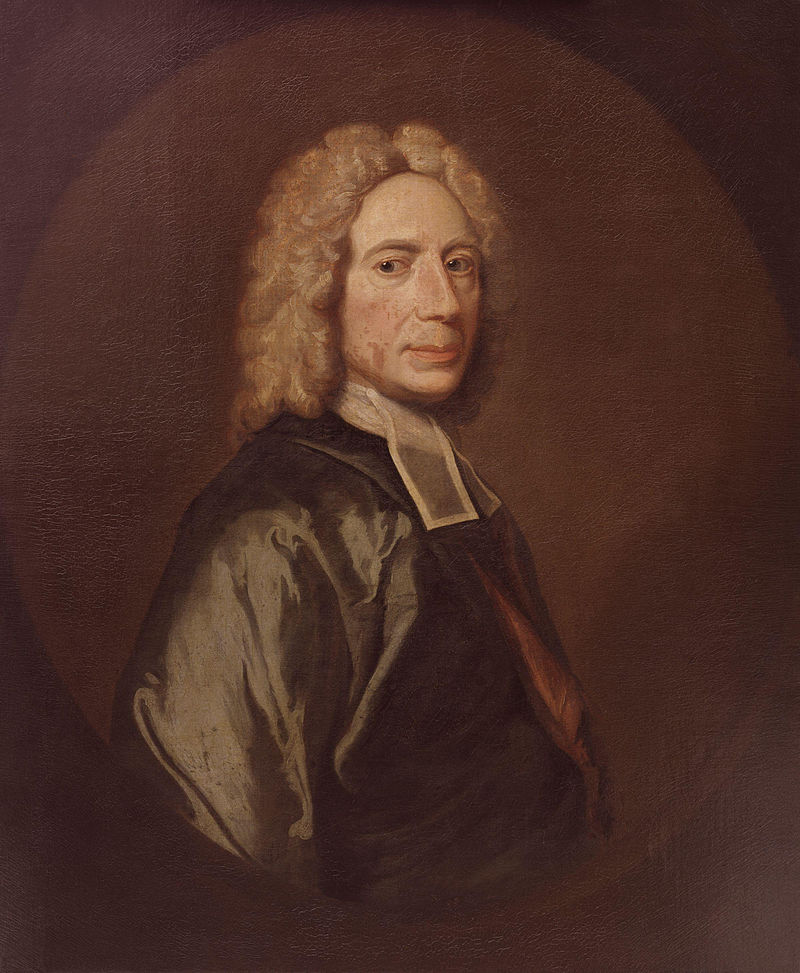
Isaac Watts (17 July 1674 – 25 November 1748) was a Congregational minister from England, renowned for his hymn writing, theology, and logic. He was a highly productive and well-known composer of hymns, with around 750 to his name. Among his notable works are “When I Survey the Wondrous Cross,” “Joy to the World,” and “O God, Our Help in Ages Past.” He is often referred to as the “Godfather of English Hymnody”; many of his hymns are still sung today and have been translated into various languages.
Watts was born in 1674 in Southampton, Hampshire, England, and raised in the household of a devoted religious nonconformist; his father, also named Isaac Watts, had been imprisoned twice for his beliefs. He received a classical education at King Edward VI School in Southampton, where he studied Latin, Greek, and Hebrew.
Watts was unable to attend Oxford or Cambridge due to being a nonconformist, as these universities were only open to Anglicans, which was also the case for government roles at the time. In 1690, he enrolled in the Dissenting Academy at Stoke Newington. A significant part of his life was spent in that village, which is now included in Inner London. After completing his education, Watts became the pastor of the large independent Mark Lane Congregational Chapel in London, where he assisted in training preachers, despite facing health challenges. His religious views were more nondenominational and ecumenical compared to what was typical for a nonconformist Congregationalist. He prioritized advancing education and scholarship over preaching for a specific denomination.
Watts worked as a private tutor and resided with the nonconformist Hartopp family at Fleetwood House on Church Street in Stoke Newington. Through them, he got to know their nearby neighbors, Sir Thomas Abney and Lady Mary. He ended up spending a total of 36 years in the Abney home, primarily at Abney House, their secondary residence. (Lady Mary inherited the manor of Stoke Newington in 1701 from her deceased brother, Thomas Gunston.)
After the passing of Sir Thomas Abney in 1722, his wife Lady Mary and their unmarried daughter Elizabeth relocated their entire household to Abney House from Hertfordshire, inviting Watts to stay with them. Watts particularly appreciated the grounds of Abney Park, which Lady Mary had designed with two elm-lined pathways leading to a heronry island in the Hackney Brook. He frequently found inspiration there for the numerous books and hymns he authored.
Watts resided at Abney Hall in Stoke Newington until his death in 1748, and he was interred in Bunhill Fields. He left behind a significant body of hymns, treatises, educational materials, and essays. His contributions had a notable impact on nonconformist independents and 18th-century religious revivalists, including Philip Doddridge, who dedicated his most famous work to Watts.


Leave a comment