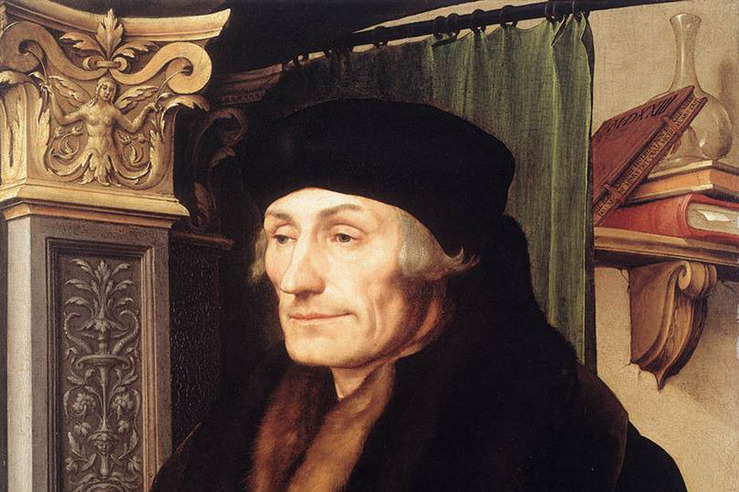
Desiderius Erasmus Roterodamus (born around October 28, 1466 – died July 12, 1536), widely recognized in English as Erasmus of Rotterdam or simply Erasmus, was a Dutch Christian humanist, Catholic priest, theologian, educator, satirist, and philosopher. His writings position him as one of the most significant intellectuals of the Northern Renaissance.
Erasmus’s life unfolded amid the rising tide of religious reform in Europe. He formulated a biblical humanistic theology advocating for both peaceful agreement and pastoral tolerance on indifferent matters, which he viewed as necessary for religion and society. Remaining in the Catholic Church throughout his life, he was dedicated to initiating reform from within. He championed what he considered the traditional doctrine of synergism, a view that prominent reformers like Martin Luther and John Calvin rejected in favor of monergism. His moderate stance often disappointed and even angered supporters from
Erasmus was a major contributor to classical scholarship known for his spontaneous, abundant, and natural style of Latin. As a Catholic priest who employed humanist methods to study texts, he produced groundbreaking new scholarly editions of the New Testament and the Church Fathers in Latin and Greek, complete with annotations and commentary that had a profound impact on both the Protestant and Catholic Reformations. His works include On Free Will, The Praise of Folly, The Complaint of Peace, Handbook of a Christian Knight, On Civility in Children, Copia: Foundations of the Abundant Style, along with many other widely-read and educational pieces.





Leave a comment