
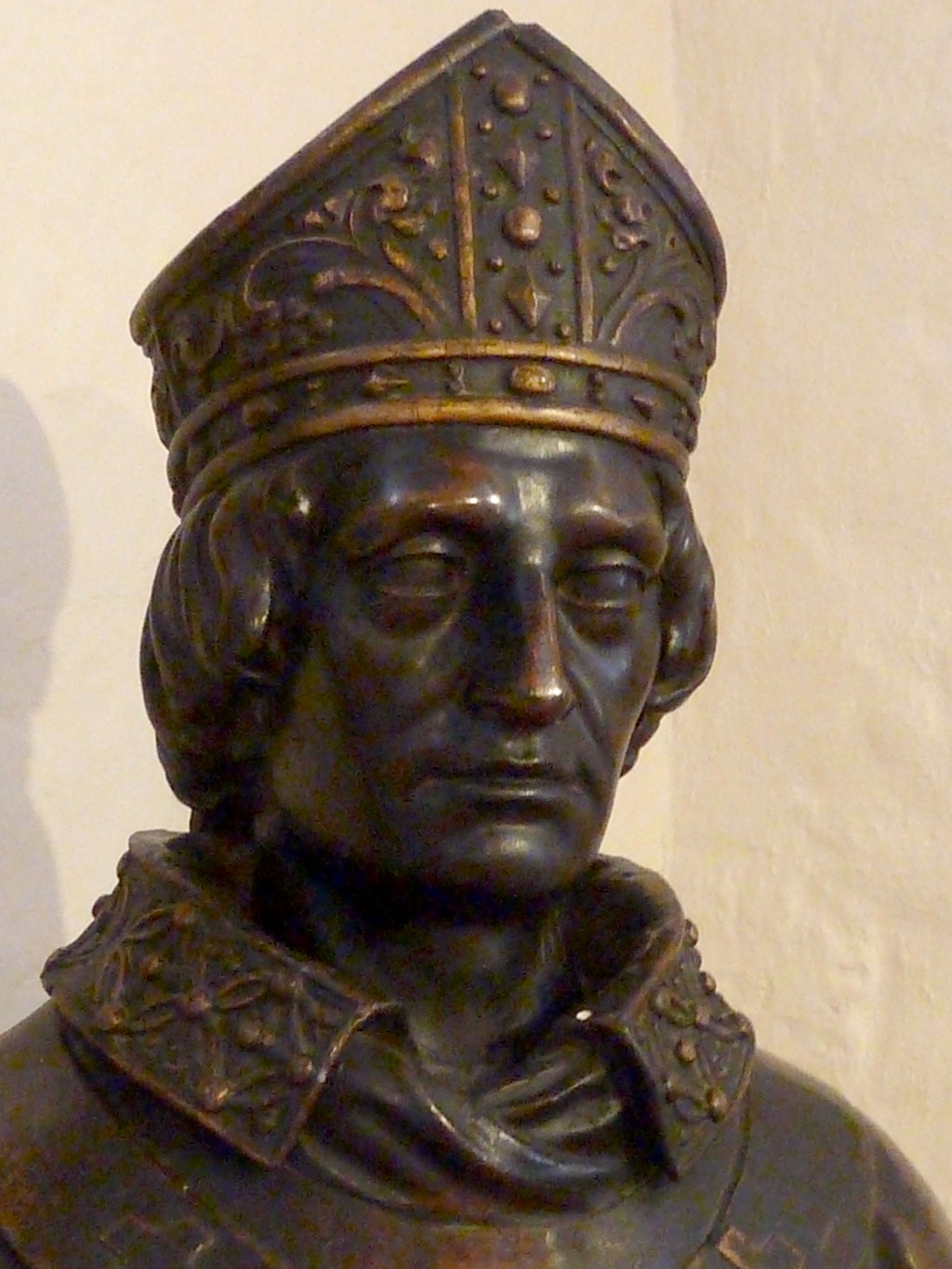
Stephen Langton (circa 1150 – 9 July 1228) served as an English cardinal in the Catholic Church and held the position of Archbishop of Canterbury from 1207 until his passing in 1228. His election led to a significant conflict between King John of England and Pope Innocent III, which was a contributing factor to the crisis that resulted in the Magna Carta of 1215. Langton is also recognized for segmenting the Bible into the contemporary chapter organization that we use today.
Langton was a prolific writer. His extensive collection of sermons, glosses, commentaries, expositions, and treatises on nearly all the books of the Old Testament are kept in manuscript form at Lambeth Palace, as well as at Oxford, Cambridge, and in France. F. J. E. Raby states, “There is little reason to doubt that Stephen Langton … was the author” of the renowned sequence Veni Sancte Spiritus. Apart from a few letters published in The Historical Works of Gervase of Canterbury, edited by W. Stubbs, and a Tractatus de translatione Beati Thomae (included in J. A. Giles’s Thomas of Canterbury, Oxford, 1845), which is likely an elaboration of a sermon he delivered in 1220 during the translation of Thomas Becket’s relics—the most magnificent ceremony ever held in England—his other works remain unpublished. Additionally, he is credited with writing a biography of Richard I, and various historical writings and poems are also attributed to him.
Traditionally, biblical scrolls were divided by blank spaces at the end (petuhoth) or in the middle (setumoth) of the lines. However, it is believed that Langton was responsible for creating the modern-day chapter divisions of the Bible. Although Cardinal Hugo de Sancto Caro is also recognized for having developed a systematic division of the Bible between 1244 and 1248, it is Langton’s chapter arrangement that is still in use today.
The “Stephen Langton Trail,” created to commemorate the 800th anniversary of the Magna Carta’s signing, begins in Langton by Wragby and proceeds to Lincoln Cathedral, which is close to Lincoln Castle, where an original copy of the charter can be found.
Stephen Langton passed away at Slindon, near Chichester, Sussex, on July 9, 1228. He was interred in an open area next to the south transept of Canterbury Cathedral. Later, St. Michael’s Chapel was constructed over this location (currently the Buffs Regimental Chapel), and his tomb’s head extends into the east end of this chapel, beneath its altar, with his feet positioned outside.





Leave a comment