
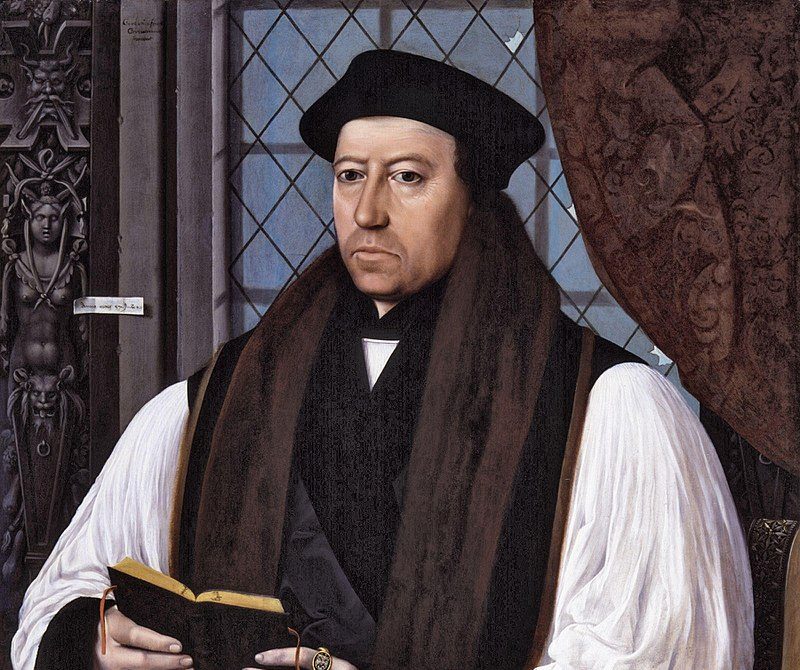
Thomas Cranmer (2 July 1489 – 21 March 1556) was a theologian, a prominent figure in the English Reformation, and served as Archbishop of Canterbury during the reigns of Henry VIII, Edward VI, and briefly, Mary I. He is celebrated as a martyr in the Church of England.
Cranmer contributed to the arguments supporting the annulment of Henry’s marriage to Catherine of Aragon, which played a significant role in the English Church’s break from the authority of the Holy See. Together with Thomas Cromwell, he backed the concept of royal supremacy, asserting that the king held sovereignty over the Church within his domain and protected his subjects from the excesses of Rome. During Cranmer’s time as Archbishop, he laid down the initial doctrinal and liturgical frameworks of the reformed Church of England. During Henry’s reign, Cranmer refrained from implementing many radical transformations in the Church due to the ongoing power struggles between conservative religious factions and reformers. He introduced the first officially sanctioned vernacular service, the Exhortation and Litany.
When Edward, who was pious and raised in the beliefs of a reformed Church, ascended the throne, Cranmer was able to accelerate reforms. He authored and compiled the first two versions of the Book of Common Prayer, providing a comprehensive liturgy for the English Church in the vernacular language. With the aid of several Continental reformers whom he sheltered, he altered doctrine or discipline in various areas, including the Eucharist, clerical celibacy, the use of images in worship, and the veneration of saints. Cranmer disseminated the new doctrines through the prayer book, the Homilies, and other writings.
Following the rise of the Catholic Mary I, Cranmer was prosecuted for treason and heresy. Imprisoned for more than two years and subjected to pressure from state and Church officials, he recanted several times and sought reconciliation with the Catholic Church. Although this would typically have cleared him of the heresy accusations, Mary insisted on his execution for treason, leading to him being burned at the stake on 21 March 1556. On the day of his execution, he publicly renounced his recantations, choosing to die as a heretic in the eyes of Catholics and a martyr for the ideals of the English Reformation. Cranmer’s death was memorialized in Foxe’s Book of Martyrs, and his influence endures in the Church of England through the Book of Common Prayer and the Thirty-nine Articles, which reflect his contributions to Anglican faith.





Leave a comment