

In this short paper I aim to explain the difference between atonement and propitiation.
An atonement is an Old Testament word. It refers to the covering of sin by blood, but not it’s removal. In the Old Testament people had a covering of sin. We know that it is not a removal because when the New Covenant is established with the righteous, one of the features of the New Covenant is the removal of all sin as far as the east is from the west. So, obviously the sin was not removed under the law, but covered and put out of sight.
Propitiation is a sacrifice that takes away the guilt of sin by the complete removal of judgment on the basis that an innocent victim has taken the full judgment of God in the sinner’s place. In the New Testament Christians have a propitiation not an atonement for sin. The guilt of sin for the Christian is removed by the blood sacrifice of Christ on the cross.
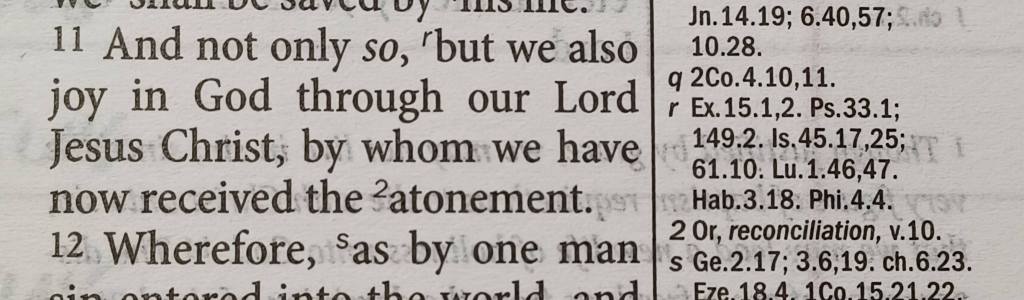
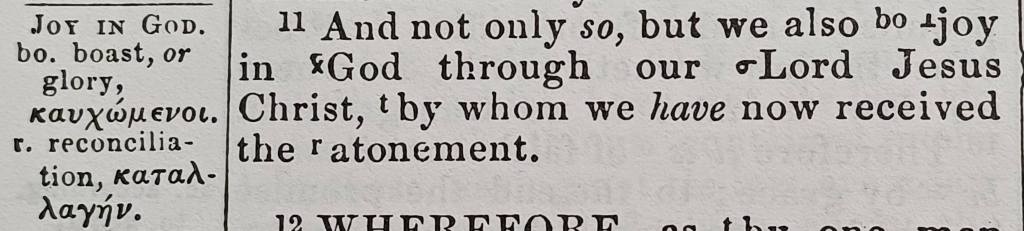
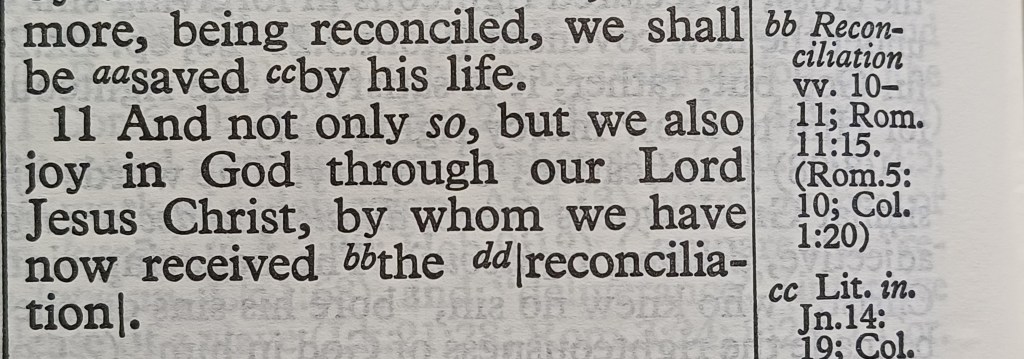
You will notice that the word atonement appears many times in the Old Testament and is not mentioned in the New Testament. Likewise with the word propitiation it is mentioned in the New Testament and not in the Old Testament. This is because the two words are different and have very different meanings and applications. I am sure that many readers of the Authorized (King James) Version will point out that there is one mention in the New Testament of the word atonement. Romans 5:11 in the KJV says, “And not only so, but we also joy in God through our Lord Jesus Christ, by whom we have now received the atonement.” However, if you turn to the same verse in other English translations the word, reconciliation appears instead of atonement. It is a shame that the King James translators wrote atonement as this is not a correct rendering of the Greek word, καταλλαγή (katallagē). Given the fact that the King James translators correctly render the same Greek word in 2 Cor. 5:18-19 as reconciliation and in Romans 11:15 as reconciling.
If you turn to Romans 5:11 in the Westminster Reference Bible, the Newberry Bible, the Scofield Reference Bible and other KJV Bibles with study notes you will see that the note relating to Romans 5:11 points out that the correct meaning and rendering of the Greek is “reconciliation” rather than “atonement”. Charles C. Ryrie picks up on this in his Study Bible. The note in the Ryrie KJV Study Bible for Romans 5:11 says, “ the atonement. Lit., the reconciliation, meaning “change.” God changes us from enemies to family. The word translated atonement is exclusively an OT word, though theologically it has come to stand for total significance of Christ’s death. On reconciliation see note on 2 Cor. 5:18.” Ryrie’s note on 2 Cor. 5:18 reads, “ reconciliation involves a changed relationship because our trespasses are not counted against us (v. 19). We are now to announce to others this message of God’s grace.”
Propitiation and atonement are distinct concepts, yet both pertain to the same issue; neither would be necessary if sin were absent. Translations of the Bible, like the NIV, that replace propitiation with atonement, undermine God’s character and diminish the significance of Christ’s work, neglecting to recognize that God’s anger requires appeasement for grace to be present. Atonement, which is about cleansing, centers on the individual, focusing on the reconciliation of sinners to God and explaining how this reconciliation takes place through the sacrifice of Christ’s shed blood. Propitiation focuses on God, specifically on placating His wrath to satisfy His righteousness and enable Him to justify those who come to Him in faith. Propitiation allows God to express His love and grace; it does not create these attributes but permits God to act in harmony with His nature, facilitating communion with humanity.
The two terms share a connection through the mercy seat located in the Ark of the Covenant, as outlined in the Mosaic Law. On the significant Day of Atonement, the high priest would take the blood from the sacrifice made on behalf of the entire community into the Holy of Holies and sprinkle it on the “mercy seat,” thus atoning for sin. Atonement occurs at the mercy seat (which may also be referred to as the propitiation), where Christ’s singular sacrifice occurs; he offered himself, fulfilling all the requirements of God’s righteousness to extend grace to those who believe.
The word propitiation relates to the idea of appeasement or satisfaction especially towards God. Propitiation involves appeasing God’s wrath towards sinners and the sinner being reconciled to God. The Bible teaches that God Himself has provide the one and only way in which His wrath can be appeased and through which mankind can be reconciled to Him. The act of propitiation refers to the work of God and not the efforts of mankind. Mankind is incapable of satisfying the wrath of God by deeds. This is why those who are outside of Christ spend eternity in hell, as in hell the wrath of God is satisfied and poured out on unreconciled sinners. This is why God sent His Son into the world, “to make propitiation for the sins of the people” (Heb. 2:17).
Propitiation is used throughout the New Testament to explain what Christ accomplished for sinners through His death on the cross.
For example, Romans 3:25 says, “whom God displayed publicly as a propitiation in His blood through faith. This was to demonstrate His righteousness, because in the forbearance of God He passed over the sins previously committed.” Hebrews 2:17 says, “Therefore, He had to be made like His brethren in all things, so that He might become a merciful and faithful high priest in things pertaining to God, to make propitiation for the sins of the people.” 1 John 2:2 says, “and He Himself is the propitiation for our sins; and not for ours only, but also for those of the whole world.” 1 John 4:10 says, “In this is love, not that we loved God, but that He loved us and sent His Son to be the propitiation for our sins.”
There are over 100 mentions of “atone” or “atonement” in the Old Testament. The New Testament makes no mention of “atone” or “atonement”. This is because the Hebrew word “kaphar” means to “to cover” or “make an atonement” and Christ’s death removes the guilt of sin rather than merely covering sin.
The Greek translation of “kaphar” namely, “exhilaskomai” never occurs in the New Testament. The New Testament writers steered clear of all the “kaphar” associations, both Hebrew and Greek. So, the English translators are correct in not using the English word “atonement” at all in the New Testament. There is no Greek word for “kaphar” in the New Testament and no English word for “kaphar” either. So how do the New Testament writers describe what Christ has accomplished for sinners. In Matthew 1:21 the word, “sōzō” is used to teach us that Christ saves us from sin. In Mark 10:45 the word, “lytraoō” is used meaning to draw out the ransom. In Romans 5:9 the word, “dikaioō” is used to point to the justification of the sinner. In the next verse (v10) Paul uses the word, “katallassō” to draw out the meaning of reconciliation. Other Greek words such as “hilastērion” is used in Romans 3:25 and Hebrews 9:5 denoting propitiation and the mercyseat. The word, “thusias” is used in Ephesians 5:2, Hebrews 7:27 and Hebrews 10:12 to show that Christ offered Himself as a sacrifice for sin. The words, “aphaireō” and “periaireō” are used to refer to Christ taking away sin.
I hope you can see that the words “atonement” and “propitiation” although they are closely related regarding sin they have two different applications and meanings. Atonement is the covering of sin, but not it’s removal. Propitiation is the removal of sin’s guilt by the blood sacrifice of Christ on the cross. People in the Old Testament under the law made an atonement for sin. In the New Testament sins are not merely covered they are completely removed. Christians have a propitiation for their sin, not an atonement.





Leave a comment