
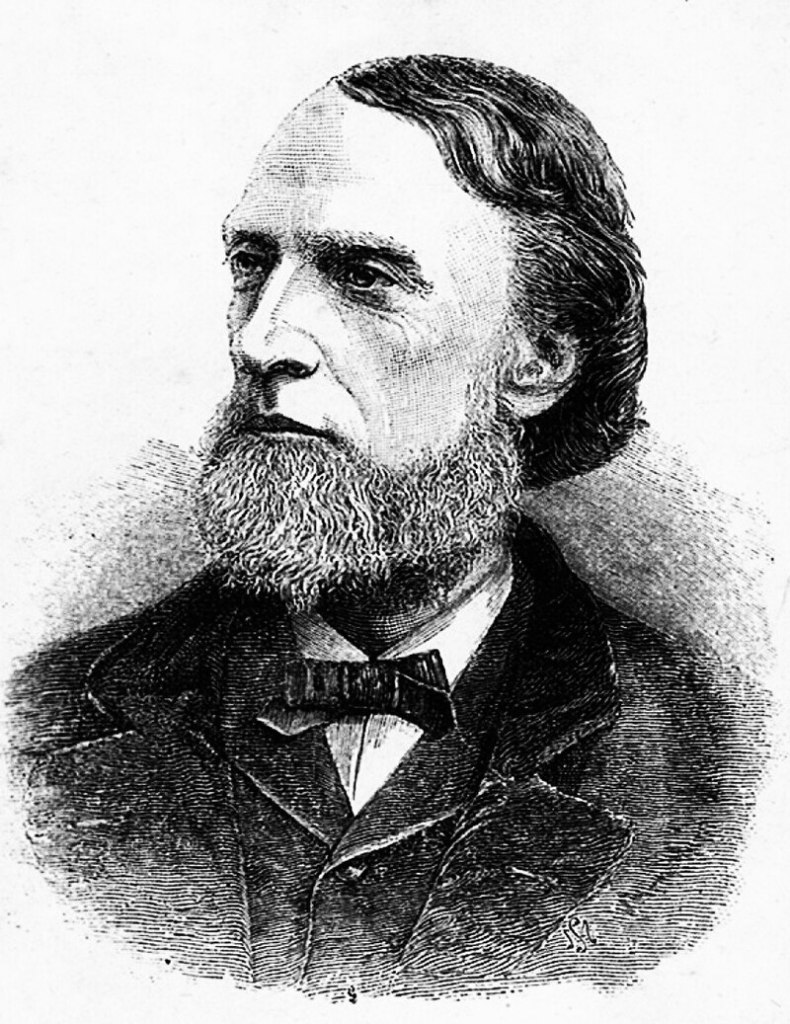
Arthur Tappan Pierson was an American Presbyterian minister, Christian figure, missionary, and author who preached more than 13,000 sermons, authored over fifty books, and conducted Bible lectures as part of a transatlantic preaching outreach that earned him recognition in Scotland, England, and Korea. He was born on March 6, 1837 in New York City, United States. He served as a consulting editor for the original “Scofield Reference Bible” (1909) at the request of his friend C. I. Scofield and was also friends with D. L. Moody, George Müller (whose biography he wrote, titled George Muller of Bristol), Adoniram Judson Gordon, and C. H. Spurgeon, whom he succeeded in the pulpit of the Metropolitan Tabernacle in London from 1891 to 1893. Throughout his lifetime, Pierson held various pulpit roles globally as an urban pastor who was deeply committed to helping the impoverished. He died on June 3, 1911.
Pierson was a pioneering supporter of faith missions who aimed to evangelize the world during his lifetime. Before 1870, there were approximately 2,000 missionaries from the United States in full-time service, with about ten percent involved in work with Native Americans. A significant surge in foreign missions began in the 1880s and continued to grow into the 20th century, partly due to Pierson’s efforts. He served as a prominent figure within the student missionary movement and was a leading evangelical proponent of foreign missions in the late 19th century. After his retirement, he traveled to Korea in 1910, where his visit led to the establishment of the Pierson Memorial Union Bible Institute (now known as Pyeongtaek University) in 1912.
Pierson was the ninth offspring of Stephen and Sallie Pierson, a family with deep Christian and abolitionist traditions. He was named after the renowned abolitionist Arthur Tappan. At the age of 13, during a Methodist revival meeting in 1850, he publicly declared his faith in Jesus Christ for the first time.
He graduated from Hamilton College in Clinton, New York, in 1857 and from Union Theological Seminary in 1869. In 1860, he married Sarah Frances Benedict, and together they had seven children, all of whom embraced Christianity before turning 15 and later took on roles as missionaries, pastors, or lay leaders.
At the age of 40, while serving as the pastor of Detroit’s largest church, he attended a series of evangelistic meetings that made him aware of his pride and greed, as well as his desire for the approval of the wealthy. Consequently, he inspired his affluent congregation to support the less fortunate in Detroit. He then worked to abolish the practice of pew rents and decided to receive his salary on a faith-based approach.
Between 1889 and 1890, he embarked on a missionary trip to the United Kingdom. Since 1888, he had been the editor of the Missionary Review of the World, and in 1891 he was a missionary lecturer at Rutgers College, followed by his role as a Duff lecturer in Scotland in 1892.
When Charles Spurgeon’s battle with Bright’s disease prevented him from preaching, he requested Pierson to take over for him while he recuperated. However, following Spurgeon’s sudden death on January 31, 1892, the congregation of the Metropolitan Tabernacle invited Pierson to continue, which he did for the ensuing two years. It is significant that Spurgeon chose a Presbyterian minister who had not undergone believer’s baptism to fill the pulpit in his absence. Pierson believed that Christians could have differing views on baptism practices and whether it should be performed on infants or only on believers. Eventually, he became convinced that baptism should be for believers, and on February 1, 1896, at the age of fifty-eight, he was baptized by Spurgeon’s brother, James A. Spurgeon.
Pierson had discussions with D. L. Moody at the Northfield Conferences and was a speaker at the Keswick Convention, where he advocated for pious holiness. During this time, George Mueller and others contributed to altering Pierson’s eschatological views from postmillennialism to premillennialism. As a missionary orator, A. T. Pierson had a significant impact on Robert Elliott Speer, Samuel Zwemer, Horace Grant Underwood, and Nobel Peace Prize laureate John R. Mott, encouraging them to dedicate their lives to mission work.
In addition to his missionary work, Pierson’s most significant impact stemmed from his dedication to orthodoxy. As liberalism began to permeate the mainline denominations, Pierson collaborated with other concerned Christian leaders to publish “The Fundamentals,” a collection of booklets aimed at addressing the criticisms of Christianity. Due to his skills in apologetics, Pierson was invited to contribute five of the key articles. These booklets were distributed at no cost to pastors across America, signaling the start of the Fundamentalist–Modernist Controversy in American churches. Eventually, the booklets were compiled into a twelve-volume series, which is still offered today in a five-volume format. Since that time, Pierson has frequently been referred to as the “Father of Fundamentalism.”
One of his most important works was “In Christ Jesus” (1898), in which he concluded that the short expression “in Christ Jesus,” consisting of a preposition and a proper noun, was fundamental to comprehending the whole New Testament. Pierson supported the concept of day-age creationism.
Upon his retirement, he kept preaching at churches and conferences both domestically and internationally. In 1910, he traveled to Korea, where he taught the Bible at several churches, including Namdaemoon church, and passed away in 1911. The Pierson Memorial Union Bible Institute, now known as Pyeongtaek University, was founded in accordance with the wishes of Dr. Arthur Tappan Pierson on October 15, 1912. Numerous pastors and scholars emerged from this institution. An illustration of an open Bible was engraved on Pierson’s gravestone. On the Bible were engraved two verses. 1 John 5:11 “God hath given to us eternal life, and this life is in His Son.” Matthew 28:19 “Go ye therefore, and teach all nations, baptizing them in the name of the Father, and of the Son, and of the Holy Ghost.”
List of Published Works by Arthur Tappan Pierson
- The Crisis of Missions (New York, 1886)
- Many Infallible Proofs: Chapters on the Evidences of Christianity (1886)
- Evangelistic Work in Principle and Practise (1887)
- Keys to the Word: or, Helps to Bible Study (1887)
- The One Gospel or, The Combination of the Narratives of the Four Evangelists (1889)
- The Divine Enterprise of Missions (1891)
- Miracles of Missions (4 vols., 1891–1901)
- The Divine Art of Preaching (1892)
- From the Pulpit to the Palm-Branch: Memorial of Charles H. Spurgeon (1892)
- The Heart of the Gospel (sermons; 1892)
- New Acts of the Apostles (1894)
- Life Power: or, Character Culture, and Conduct (1895)
- Lessons in the School of Prayer (1895)
- Acts of the Holy Spirit (1895)
- The Coming of the Lord (1896)
- Shall we continue in Sin? (1897)
- In Christ Jesus: or, The Sphere of the Believer’s Life (1898)
- Catharine of Siena, an ancient Lay Preacher (1898)
- George Muller of Bristol and his Witness to a Prayer-Hearing God (1899)
- Forward Movements of the last half Century (1900)
- Seed Thoughts for Public Speakers (1900)
- The Modern Mission Century viewed as a Cycle of Divine Working (1901)
- The Gordian Knot: or, The Problem which baffles Infidelity (1902)
- The Keswick Movement in Precept and Practice (1903)
- God’s Living Oracles (1904)
- The Bible and Spiritual Criticism (1906)
- The Bible and Spiritual Life (1908)
- Godly Self-control (1909)




Leave a comment