
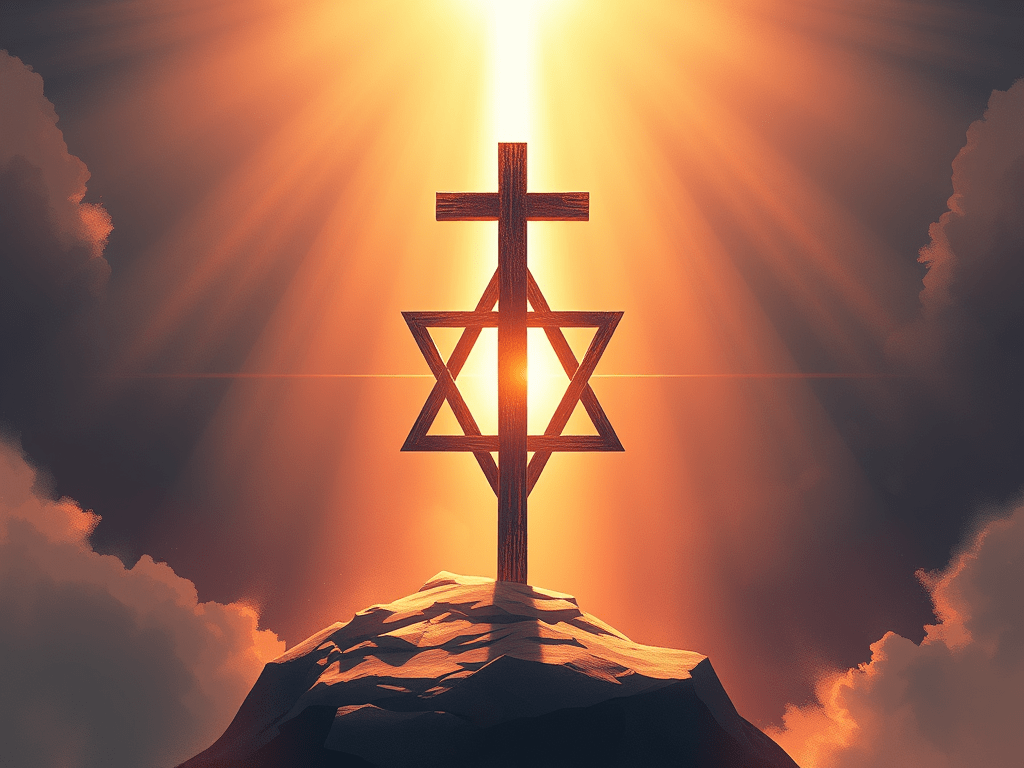
In the Old Testament, we see God dealing with a specific group of people called the Jews or Israelites and a nation called Israel. In the New Testament, we see God dealing with a group of people called Christians and The Church. Are the two separate, or is the Church a continuation of God’s people in the Old Testament called Israel? In this paper, I aim to answer that question and set out some key scriptures and points to show why the dispensational view of Israel and the Church is in keeping with Holy Scripture. Israel was chosen by God for a fourfold mission. Firstly, to witness, to the unity of God in the midst of Idolatry. Secondly, to witness to other nations the blessings of serving God. Thirdly, to receive and preserve the Holy Scriptures. Fourthly, to be the human means to bring the Messiah into the world.
A dispensationalist believes in a clear distinction between Israel and the church. In “The Hermeneutics of Dispensationalism” Fuller writes, “the basic premise of Dispensationalism is two purposes God expressed in the formation of two peoples who maintain their distinction throughout eternity.” In his book, “Dispensationalism” Lewis Sperry Chafer writes, “The dispensationalist believes that throughout the ages God is pursuing two distinct purposes: one related to the earth with earthly people and earthly objectives involved which is Judaism; while the other is related to heaven with heavenly people and heavenly objectives involved, which is Christianity.… Over against this, the partial dispensationalist, though dimly observing a few obvious distinctions, bases his interpretation on the supposition that God is doing but one thing, namely, the general separation of the good from the bad, and in spite of all the confusion this limited theory creates, contends that the earthly people merge into the heavenly people; that the earthly program must be given a spiritual interpretation or disregarded altogether.”
This is the test of whether someone is a dispensationalist or not. The person who does not see a distinction between Israel and the church is not a dispensationalist.
Although the focus of Scripture is primarily on God’s purpose for Israel and the church, He also has intentions for other groups. There is a specific purpose and plan for the angels, separate from His plans for Israel or the church (2 Peter 2:4; Rev. 4:11). He has intentions for those who turn away from Him, which are also separate from other purposes (Prov. 16:4). Additionally, there is a plan for the nations, which extends into the New Jerusalem (Rev. 22:2), and these nations are different from the bride of Christ. While God reveals more about His plans for Israel and the church, He has more than just two purposes overall. Classic dispensationalism is a result of consistent application of the basic hermeneutical principle of literal, normal, or plain interpretation. No other system of theology can claim this. Non-dispensationalists blur the distinction between Israel and the church. By doing so they fail to understand the contrast that is consistently in Scripture. Use of the words Israel and church shows that in the New Testament national Israel continues with her own promises and that the church is never equated with a so-called “new Israel” but is carefully and continually distinguished as a separate work of God in this current dispensation known as the Church Age.
The comprehension of Old Testament prophecies naturally leads to the clear and consistent differentiation between Israel and the church, which is a crucial element of dispensationalism. Unlike other perspectives that associate the church with the fulfillment of Israel’s prophecies, dispensationalism does not. The amillennialist argues that the church entirely realizes Israel’s prophecies, acting as the true spiritual Israel. The covenant premillennialist incorrectly sees the church as fulfilling Israel’s prophecies in certain aspects since both represent the people of God, while also maintaining the millennial period as a time of fulfillment. The progressive dispensationalist asserts that the prophecies regarding Christ’s Davidic reign have begun to be realized in heaven. The understanding of how and when Israel’s prophecies are fulfilled is directly related to one’s ability to clearly and consistently distinguish between Israel and the Church.
For those who do believe that the church is a continuation of Israel and that the church has inherited Israel’s promises and blessings I will say the following.
1). We are not spiritual Israel.
2). We do not inherit Israel’s promises.
3). We were not given Israel’s Great Commission.
4). We do not celebrate Israel’s feasts.
5). We do not practice Israel’s traditions.
6). We do not perform Israel’s rituals.
7). We do not apply Christ’s instructions to Israel from His earthly ministry to the church.
Deu 7:6 says, “For you are a holy people to the Lord your God; the Lord your God has chosen you to be a people for Himself, a special treasure above all the peoples on the face of the earth.” The Jewish people are a chosen and special people. Israel is a national and separate ethical people. They have been chosen and preserved by God. We hear nothing about groups of people such as the Jebusites and Perizzites today, but we do hear about the Israelites, The Children of Israel.
One of the clearest differences between Israel and the church is the fact that Israel are the actual physical children and descendants of Abraham, but the Church are the spiritual children of God. Take for example 1 Cor 10:32, “Give no offense, either to the Jews or to the Greeks or to the church of God.” Here there are three distinct groups; Jews – National Israel, Greeks or Gentiles meaning the other nations of the world and the Church of God, believers in the Gospel.
Let us look at some more clear difference in the Scripture where there is a distinction between Israel and the church.
Israel is a nation of people who are born after the flesh of Abraham and his descendants. Exo 19:5, “Now therefore, if you will indeed obey My voice and keep My covenant, then you shall be a special treasure to Me above all people; for all the earth is Mine.” The church is not a nation. The church is a body of believers who are in Christ and are from every tongue, tribe and nation of the world. Rom 10:19, “But I say, did Israel not know? First Moses says: “I will provoke you to jealousy by those who are not a nation, I will move you to anger by a foolish nation.” 1 Cor 12:12-13 says, “For as the body is one and has many members, but all the members of that one body, being many, are one body, so also is Christ. For by one Spirit we were all baptized into one body—whether Jews or Greeks, whether slaves or free—and have all been made to drink into one Spirit.” Col 1:24 says, “I now rejoice in my sufferings for you, and fill up in my flesh what is lacking in the afflictions of Christ, for the sake of His body, which is the church.”
God’s dealing with Israel focused on the land. Gen 12:1 says, “Now the Lord had said to Abram: “Get out of your country, From your family And from your father’s house, To a land that I will show you.” The church is not centred on a land. In fact the church is called to go out to every nation. Matt 28:19-20 says, “Go therefore and make disciples of all the nations, baptizing them in the name of the Father and of the Son and of the Holy Spirit, teaching them to observe all things that I have commanded you; and lo, I am with you always, even to the end of the age.” Amen.” Israel was recognised by other nations (Num. 14:15 and Jos. 5:1). The church was a mystery not known in the Old Testament (Rom. 16:25-26, Eph. 3:1-6 and Col. 1:25-27).
Another major difference is law and grace. Israel was under the law of Moses (John 1:17) and the church is under grace and the law of Christ. 1 Cor 9:21 says, “to those who are without law, as without law (not being without law toward God, but under law toward Christ), that I might win those who are without law.” Gal 6:2 says, “Bear one another’s burdens, and so fulfill the law of Christ.” Rom 6:14 says, “For sin shall not have dominion over you, for you are not under law but under grace.”
Israel had a priesthood that was specific to the tribe of Levi (Num. 3:6-7). The church is different in respect to the fact that all Christians are priests unto God. This is called the priesthood of the believers.
Israel worshiped at the tabernacle and later at the temple (Exd. 40:18-38 and 2 Chron. 8:14-16). The New Testament tells us that the body of the Christian is the temple of God. 1 Cor 6:19-20 says, “Or do you not know that your body is the temple of the Holy Spirit who is in you, whom you have from God, and you are not your own? For you were bought at a price; therefore glorify God in your body and in your spirit, which are God’s.” Believers gather together in a local fellowship which is known as the church in that area. 1 Cor 16:19, “The churches of Asia greet you. Aquila and Priscilla greet you heartily in the Lord, with the church that is in their house.”
Israel offered animal sacrifices to God to atone for their sins (Lev. 4: 1-35). Under the law, sins were covered by the animal sacrifices. When the children of Israel transgressed the law they had to make a sacrifice for sin. Their sins were only covered and put out of sight, but they were not removed. Rom 12:1 says, “I beseech you therefore, brethren, by the mercies of God, that you present your bodies a living sacrifice, holy, acceptable to God, which is your reasonable service.” The sacrifice of the church is spiritual; it is worship, praise, honour and service to God. Under grace sins are completely removed. 1 John 1:7 testifies to this fact, “but if we walk in the light as He is in the light, we have fellowship with one another, and the blood of Jesus Christ His Son cleanses us from all sin.” Heb 10:12 says, “But this Man, after He had offered one sacrifice for sins forever, sat down at the right hand of God.” Israel did not have a removal of their sins, but a covering. Believers in the Lord Jesus Christ (the church) have a removal of their sins by faith in the Saviour. The blood of Christ removes the penalty and judgement of sinners.
The reasons outlined clearly demonstrate that Israel and the church are fundamentally different entities. These two groups are distinctly differentiated within the pages of Scripture, and it is evident that God has unique plans and methods for interacting with both Israel and the church. Consequently, these differences justify the dispensational perspective, which posits that Israel and the church have separate roles and purposes in God’s overarching narrative. This dispensational view aligns consistently with the teachings found in Scripture and should, therefore, be recognized and accepted as an accurate reflection of the truths presented in Holy Scripture.
Published in: No 2 The Journal of the Home Bible College Feb 2025





Leave a comment