
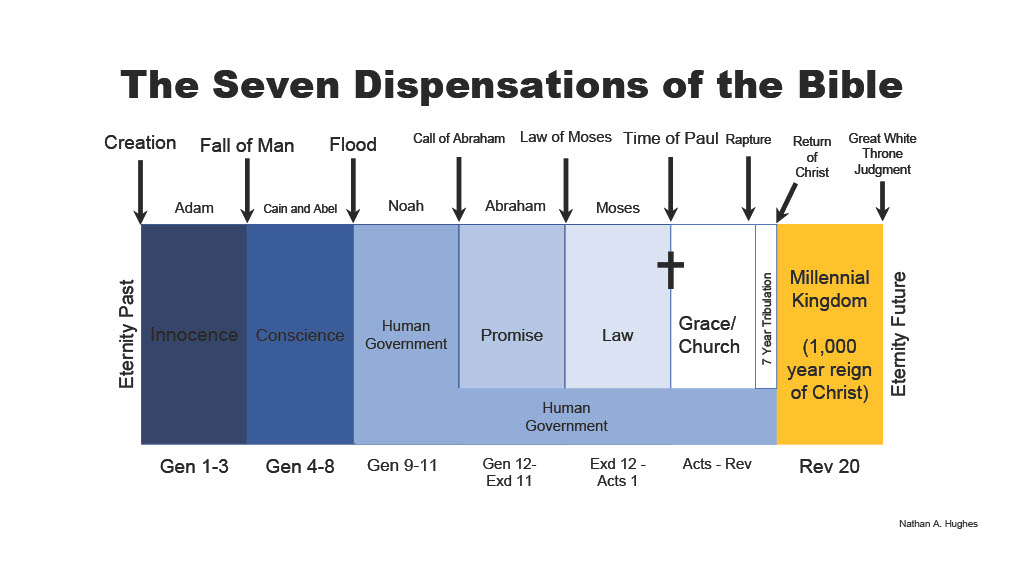
Dispensationalism teaches that God deals with mankind in different ways in different periods of time. Normally there are seven dispensations of God throughout history. Some people believe there are 5 or 9 dispensations. However, there are at least seven clear dispensations found in Scripture from a Classic Dispensational viewpoint. In this short article, I aim to set out what the seven dispensations are. I am merely writing this as an academic study and not from my personal viewpoint on the topic.
1. Innocence (Gen 1-3)
The first dispensation found in Scripture covers the period of Adam and Eve in the Garden of Eden. God made commands in this dispensation. They were to fill the earth with children, subdue the earth, have dominion over the animals, care for the garden and not eat from the tree of knowledge. God told Adam and Eve that the consequences of breaking his commandment would be physical and spiritual death. This dispensation ended when Adam and Eve sinned and were kicked out of the Garden of Eden.
2. Conscience (Gen 4-8)
This dispensation lasted for about 1,600 years from the time of Adam and Eve until the flood. In this dispensation, God teaches us that left to our own conscience and will mankind will choose sin over holiness. There are five major points in this dispensation. They are as follows a curse on the serpent, pains in childbearing, a curse on nature, the hardship of work and the promise of God to send the Messiah who will bruise Satan’s head.
3. Human Government (Gen 9-11)
Under this dispensation, God had already destroyed life on earth with a flood saving just 8 people to replenish the earth. God made promises to Noah and his family under this dispensation. God promised to never curse the earth again with a worldwide flood and the rainbow is a sign of this promise. God allowed the eating of meat and the establishment of capital punishment under this dispensation. Noah and his family had dominion over the animal kingdom also. Under this dispensation, Noah and his family had the responsibility of replenishing and filling the earth. About 325 years after the flood the inhabitants began to build a tower of human pride (Gen 11:7-9). God brought this to an end and confused the languages of the world. The reason why we have so many different languages and cultures is because of the Tower of Babel. From this point on human government has been part of the world.
4. Promise (Gen 12 – Exod 11)
The fourth dispensation began with the call of Abraham and ended with the Exodus of the Jewish people from Egypt. This period of time covers about 430 years. During this time period, God made a great nation that he chose to be His people (Genesis 12:1-Exodus 19:25). The main point in this dispensation is the Abrahamic Covenant. Here are some key points under this covenant. From Abraham, a great nation would arise and God would bless that nation. God would make the name of Abraham great and would bless those who blessed Abraham and curse those who cursed Abraham. God promised that in Abraham all the families of the world would be blessed which is fulfilled in Christ’s death on the cross. The sign of this covenant is circumcision.
5. Law (Exod 12-Acts 1)
The next dispensation lasted almost 1500 years from the time of the Exodus until after the death of Christ. It is believed that this dispensation of law will continue during the millennial reign of Christ. During this dispensation, God deals specifically with the nation of Israel and the Jewish people by what is called the Mosaic Covenant (Exd 19-23). As a result of continual rejection of God the tribes of Israel lost the promised land and were scattered over the earth.
6. Church/Grace (Acts 2-Rev)
This dispensation is where we are now. We are currently living in the “Church Age” or “Age of Grace.” It is clear to see that we do live in a time of grace. God is not pouring out his wrath and judgment on the world like he did in Genesis, for example. The Church Age began with the New Covenant in Christ’s blood (Luke 22:20). It is a matter of debate when the Church Age started. However, the most likely and clearest view from Scripture is the day the Lord poured out his spirit on the Day of Pentecost. The Church Age of God’s grace will end with the Rapture of the church (1 Thess 4). Our responsibility in this dispensation is to repent and believe the Gospel. This dispensation has lasted for over 2000 years and the time it will end is known only unto God.
7. Kingdom (Rev 20)
The seventh and last dispensation is called the Millennial Kingdom of Christ. This dispensation will last for 1000 years when Christ shall reign as Judge on earth. This is often called the Second Coming of Christ. The only people that will be allowed to enter this Kingdom of Christ will be those who are born-again believers from the Church Age and all the Old Testament saints that were saved by faith in God. This dispensation will end with the final judgment (Rev 20:11-14). The world will be destroyed by fire and a New Heaven and a New Earth will be established (Rev 21-22).
Conclusion
In closing, I would just like to say the following. If you disagree with dispensationalism then you must acknowledge that there are at least two distinct dispensations in the Bible, Old Testament and New Testament. You must acknowledge that there is a difference between how God is working through the Old Testament law and how He works in the New Testament Church. There are laws in the Old Testament that are not for us today, but for a time in history for Israel.
It’s a common misunderstanding that dispensationalism teaches different ways of salvation. Salvation in the Old Testament is the same in the New Testament. Salvation has and will always be by faith. In the Old Testament people were saved by believing in the promises of God and that He would send the Messiah through the line of David. In the Old Testament salvation was by looking forward to the cross and in the New Testament we look backwards to the cross. Salvation has never been by works.
Those who believe in dispensationalism are often accused of rejecting the teaching of covenants. This is not true. Dispensational Christians do believe in covenants. They typically believe in five Biblical covenants they are Noahic, Abrahamic, Mosaic, Davidic and Messianic. However, this is not to be confused with Covenant Theology which Dispensationalists do not believe in. Covenant Theology teaches three covenants of God. They are the Covenant of Redemption, Covenant of Works and Covenant of Grace. Covenant Theology does not make a clear distinction between Israel and the Church, unlike Dispensationalism does. The other major difference between the two is the literal 1000-year reign of Christ on earth. Dispensationalism teaches that Christ will reign on earth for a literal thousand years as Covenant Theology does not promote a literal thousand-year reign.
It is also worth mentioning the topic of Replacement Theology. Those who believe in Covenant Theology believe that God has finished with the Nation of Israel and that the Church has replaced Israel as God’s chosen people. Dispensationalism teaches that the Nation of Israel has been set aside for now in this current dispensation of the Church Age, but God is not finished with the Nation of Israel and there will be a time of national repentance and revival in Israel among the Jewish people.




Leave a comment